


What Is Codex? OpenAI’s AI Agent for Software Development (TickTockIT)
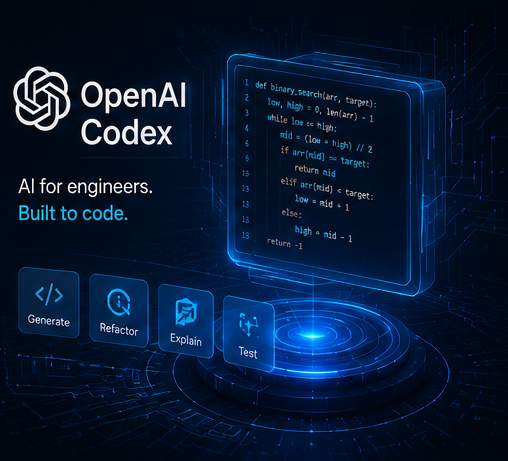
Codex is OpenAI’s AI agent for software development. It can inspect source code, understand a software project, edit files, run commands, execute tests, investigate failures, review changes, and help developers complete practical engineering work.
Unlike a conventional chatbot that merely displays a code example, Codex can work directly with a development environment or repository. It can examine how a project is structured, decide which files need to change, implement those changes, test the result, and present its work for review.
Codex is designed to assist with tasks such as building features, fixing bugs, refactoring applications, writing tests, reviewing pull requests, updating documentation, automating repetitive work, and explaining unfamiliar codebases.
Codex Is an AI Coding Agent
Codex is best understood as an AI coding agent rather than a simple code generator. A code generator usually responds to a prompt by producing a snippet of source code. An agent can perform a sequence of connected actions in pursuit of a larger objective.
For example, a developer might ask Codex to add a customer export function to an existing PHP application. Codex can inspect the project, locate the relevant database queries, identify the user interface, add the export logic, update the page, run available checks, and summarise the resulting changes.
This agentic workflow is important because real software development rarely involves writing one isolated function. Most tasks require understanding dependencies, conventions, data flows, security controls, user interfaces, and the effect a change may have elsewhere in the application.
How Codex Differs from Standard ChatGPT Coding
A standard ChatGPT conversation is useful for asking technical questions, discussing architecture, generating examples, and troubleshooting code pasted into the conversation.
Codex is focused more directly on carrying out software-development work. Depending on the Codex environment being used, it can work with repositories, local folders, terminals, development tools, isolated worktrees, cloud environments, and Git-based workflows.
The practical difference is that ChatGPT often advises you what to change, while Codex can inspect the actual project and implement the change. The developer still remains responsible for reviewing, testing, approving, and deploying the result.
Understanding an Existing Codebase
One of the most valuable Codex capabilities is codebase understanding. Before modifying a project, Codex can inspect directories, source files, configuration files, database code, tests, dependencies, and documentation.
It can trace how a request moves through an application, identify where values are stored, locate the functions responsible for a feature, and determine how different components interact.
This is particularly useful when dealing with older applications, poorly documented systems, unfamiliar repositories, or software developed by several people over many years.
Generating New Code
Codex can generate code from natural-language instructions. A developer can describe the required behaviour, constraints, programming language, framework, and expected output.
It can produce individual functions, complete pages, command-line tools, database queries, API integrations, configuration files, automated tests, scripts, and application components.
The quality of the result depends heavily on the quality of the instruction and the information available in the project. Clear acceptance criteria generally produce more dependable work than vague requests such as “make this better.”
Editing Existing Software
Most commercial development work involves changing software that already exists. Codex can modify existing files while attempting to preserve the current architecture, naming conventions, coding style, and behaviour.
It can add a feature to a live application, change the structure of a database query, repair a broken form, improve validation, update an API call, alter a user interface, or migrate code to a newer library.
Because Codex can inspect surrounding files, it can often make a more context-aware change than a tool that sees only one pasted code fragment.
Debugging and Fault Investigation
Codex can assist with debugging by examining error messages, logs, stack traces, application state, failing tests, and the source code surrounding a fault.
It can form a hypothesis about the cause, inspect the relevant implementation, apply a correction, and run a test or command to check whether the failure has been resolved.
This does not guarantee that every diagnosis will be correct. Intermittent faults, hardware problems, production-only failures, incomplete logs, external service issues, and undocumented behaviour can still require detailed human investigation.
Running Commands and Tests
A major difference between an AI agent and a conventional text assistant is the ability to use tools. Codex can run permitted commands in its working environment and inspect the results.
It may run unit tests, integration tests, linters, type checkers, build tools, package managers, search commands, database migrations, and project-specific validation scripts.
This feedback loop allows Codex to detect some mistakes before presenting its work. If a test fails, it can inspect the error, revise the implementation, and test again.
Writing Automated Tests
Codex can create automated tests for existing or newly written code. It can examine a function or feature, identify expected behaviours, and build tests covering normal operation, boundary conditions, invalid input, and known failure cases.
Tests are especially important when AI-generated code is introduced into an established system. A plausible-looking implementation is not sufficient evidence that the code behaves correctly.
Good test coverage gives developers a repeatable way to confirm that the requested feature works and that existing behaviour has not been unintentionally damaged.
Refactoring Code
Refactoring changes the internal structure of software without intentionally changing its external behaviour. Codex can help reorganise complex code, remove duplication, split large functions, improve naming, simplify conditional logic, and introduce clearer abstractions.
It can also assist with larger migrations, such as replacing an obsolete library, updating an API integration, converting legacy syntax, or restructuring a project into more maintainable components.
Refactoring carries risk because subtle behaviour may depend on code that initially appears unnecessary. Tests, source control, code review, and staged deployment remain essential.
Code Review
Codex can review proposed changes and identify potential defects, insecure patterns, missing validation, inadequate error handling, unintended behavioural changes, and maintainability problems.
It can compare a change against the surrounding codebase and explain why a particular implementation may be risky.
AI-assisted review can provide an additional layer of inspection, but it should not be treated as an infallible approval mechanism. Important changes still require review by someone who understands the system, its users, and its operational consequences.
Working with Git and Pull Requests
Codex can participate in Git-based development workflows. It can inspect differences between revisions, make changes in a branch or isolated worktree, summarise modifications, and prepare work for review.
In supported workflows, Codex can help complete pull requests, respond to review feedback, investigate failing checks, or propose a pull request containing a completed task.
The use of branches and reviewable diffs is important. It separates proposed AI-generated work from the main production branch and allows every changed line to be inspected before it is merged.
Using Codex with PHP Applications
Codex can assist with PHP development by creating and editing forms, database operations, session handling, authentication, email functions, PDF generation, REST APIs, and administrative interfaces.
For an existing job-management system, Codex might add editable task records, CSV exports, Microsoft Graph email delivery, VAT calculations, invoice numbering, digital signatures, or JSON backups.
PHP applications vary considerably in quality and architecture. Codex must be given access to the relevant files and clear instructions about the PHP version, database, framework, hosting environment, and security requirements.
Using Codex with WordPress
Codex can help create WordPress plugins, child-theme functions, shortcodes, REST endpoints, custom post types, role checks, protected download handlers, and Elementor-compatible HTML, CSS, JavaScript, and PHP.
It can investigate plugin conflicts, identify invalid selectors, explain template behaviour, or modify code to follow WordPress hooks and coding conventions.
WordPress changes must be tested on a staging site before deployment. A small mistake in a theme function or plugin file can cause a fatal error, expose information, or make an entire website unavailable.
Using Codex with Python
Python is well suited to Codex-assisted development because it is widely used for automation, data processing, web applications, artificial intelligence, system administration, and command-line tools.
Codex can build Flask or Django applications, create data-processing scripts, package applications, add logging, write tests, manage dependencies, and investigate tracebacks.
It can also help convert an experimental script into a more maintainable project with configuration files, validation, structured error handling, documentation, and automated tests.
Using Codex with PowerShell
Codex can create and troubleshoot PowerShell scripts for Windows administration, Microsoft 365, Active Directory, Entra ID, Intune, Exchange Online, file management, registry changes, reporting, and software deployment.
Administrative scripts can have a large operational impact. A command that changes permissions, removes accounts, modifies mailboxes, or deploys configuration across many devices must be reviewed carefully.
Scripts should include validation, logging, error handling, confirmation controls, and a safe way to test against a limited scope before broad deployment.
Security and Permission Boundaries
Codex may work with source code, terminals, configuration, repositories, network services, and development credentials. These capabilities create genuine security considerations.
The agent should receive only the permissions required for the task. Production credentials, unrestricted cloud permissions, customer data, private keys, and administrative tokens should not be exposed unnecessarily.
Sandboxing, approval controls, constrained execution, network policies, audit logs, protected branches, and isolated development environments reduce the risk of unintended actions.
Hallucinations and Incorrect Code
Codex can produce code that appears professional but is incomplete, insecure, incompatible, or factually wrong. This is often described as hallucination.
It may call a function that does not exist, assume the wrong library version, misunderstand a business rule, omit an edge case, or report that a task has succeeded when only part of it has been tested.
This is why generated code must be inspected and verified. Fluency is not the same as correctness.
Human Oversight Remains Essential
Codex can accelerate development, but it does not own the business requirements, customer relationship, legal obligations, operational risk, or final technical decision.
A human developer must determine whether a proposed change is appropriate, secure, maintainable, compliant, and ready for deployment.
The most effective model is supervised automation: Codex performs well-defined technical work while a knowledgeable person sets objectives, controls access, reviews results, and approves consequential actions.
Advantages of Codex
Codex can substantially reduce the time required for code exploration, routine implementation, debugging, testing, documentation, and repetitive maintenance.
- Rapid inspection and explanation of existing projects.
- Context-aware editing across multiple files.
- Assistance with debugging and test failures.
- Generation of tests and documentation.
- Automation of repetitive engineering tasks.
- Support across numerous programming languages and tools.
- Parallel work through isolated tasks and worktrees.
- Reviewable changes integrated with Git workflows.
Limitations of Codex
Codex does not have perfect knowledge of a project, and it cannot infer every undocumented requirement. Its work is limited by the available context, environment, permissions, tools, and quality of the task description.
It can misunderstand complex architecture, introduce regressions, create inefficient solutions, miss security implications, or make a local change that conflicts with a wider organisational requirement.
It is also less reliable when a task depends on unavailable production data, inaccessible systems, physical hardware, undocumented third-party behaviour, or subjective design decisions.
Final Thoughts
Codex is an AI software-development agent capable of doing considerably more than generating isolated code snippets.
It can inspect repositories, understand project structure, edit multiple files, run commands, execute tests, investigate errors, review changes, and assist with complete engineering tasks.
Its real value comes from combining language-model reasoning with access to practical development tools and controlled working environments.
However, Codex is not an automatic guarantee of correct or secure software. Its output must be treated as proposed engineering work: inspect it, test it, challenge its assumptions, and keep a human responsible for the final decision.
Used with clear instructions, restricted permissions, source control, automated tests, staging environments, and disciplined review, Codex can become a powerful addition to a modern software-development workflow.