

Cyborgs, Replicants, Androids and the Evolution of Artificial Intelligence
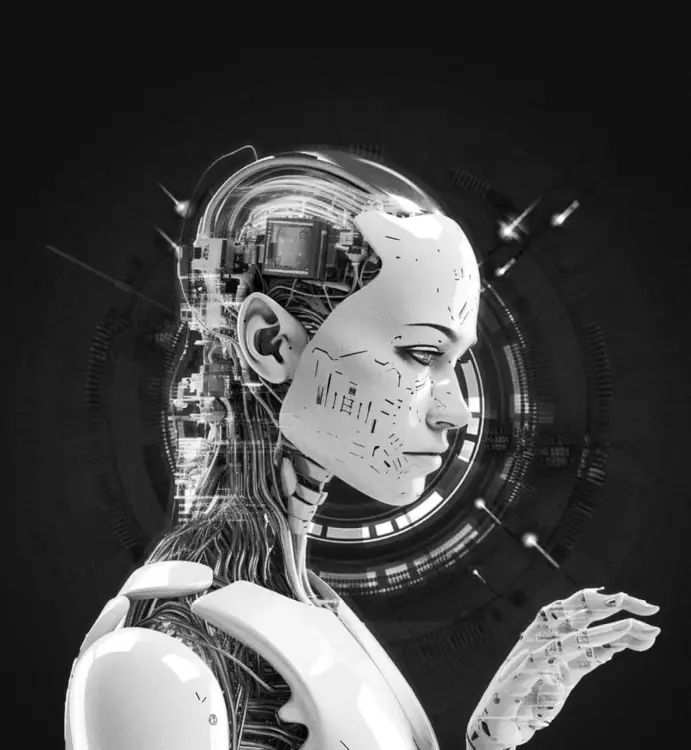
Cyborgs, replicants and androids are often grouped together in science fiction, but they begin from fundamentally different places. A cyborg starts as a living biological organism enhanced by technology; a replicant is an artificially grown or bioengineered organism; and an android starts as a manufactured machine designed to resemble or behave like a person.
The distinctions become more important when artificial intelligence is added. An agentic cyborg combines a living organism with technology capable of planning and taking actions. An agentic android places similar autonomous capabilities inside an entirely manufactured body. A sufficiently advanced replicant could appear similar to either, yet its biological origin would still put it in a separate category.
This comparison describes what is real today, what remains experimental, what is theoretical, and what is still fictional. It also separates four different ways of classifying AI: by capability, by functionality, by application, and by the physical form in which the AI operates.
The Three Origins: Biological, Bioengineered and Mechanical
Cyborg: a naturally born human or animal whose abilities are restored, supported or extended by integrated technology. Pacemakers, cochlear implants, neural interfaces, powered prostheses and artificial organs can all be described as cyborg technologies, although people who use medical devices do not necessarily identify as cyborgs.
Replicant: an artificially grown, bioengineered being. The term is most strongly associated with science fiction and does not identify a recognised class of real person today. Modern biotechnology can grow tissues, organoids and engineered biological structures, but it cannot produce a mature, adult, human-equivalent being with implanted memories and designed intelligence.
Android: a manufactured robot with a humanlike body or appearance. Humanoid robots exist, but present machines remain limited by battery capacity, dexterity, perception, reliability, cost and the difficulty of operating safely in unstructured environments.
Cyborgs: The Present Position
Cyborgs are the only one of the three physical categories that unquestionably exists today under a broad technical definition. The biological person remains the centre of identity and decision-making, while the machine component restores or enhances a function.
Current examples include cardiac implants, insulin pumps, retinal and cochlear implants, myoelectric limbs, exoskeletons and experimental brain–computer interfaces. Most are medical or assistive systems rather than superhuman enhancements. They normally perform a narrow purpose and remain under direct human control.
The boundary is debatable. Wearing glasses or carrying a smartphone does not usually make someone a cyborg because the technology is external and easily separated. An implanted, continuously interacting device makes the description more convincing, but there is no single scientific or legal threshold.
The Future of Cyborgs
Future cyborg technology is likely to progress from replacement towards augmentation. More responsive prostheses may provide touch and position feedback; neural interfaces may restore communication or movement; artificial organs may become more capable; and wearable or implanted systems may continuously adjust to an individual's condition.
Progress will probably be gradual rather than a sudden transformation into science-fiction superhumans. Surgery, infection, long-term biocompatibility, device failure, cybersecurity, battery life, affordability and informed consent are serious constraints.
The social questions may be as difficult as the engineering: who owns the data, who is permitted to update an implant, whether employers can demand augmentation, and whether enhancements create a divide between people who can and cannot afford them.
Agentic Cyborgs
An agentic cyborg would combine a biological organism with an AI component able to interpret goals, plan steps, use tools and act with some independence. A closed-loop medical implant that senses a condition and adjusts treatment already shows a limited version of this idea, but it is not a general autonomous partner.
Today, the human normally remains the principal agent. The implanted or attached system operates within a narrow, pre-authorised function. It does not possess its own general understanding, personal motives or legal identity.
In the future, an AI assistant could become continuously connected to a person's senses, memory aids, mobility systems or communications. That could improve independence and capability, but it would blur responsibility. If an autonomous implant makes a harmful decision, responsibility could be divided among the user, clinician, manufacturer, software provider and AI operator.
Replicants: Biology Built in a Laboratory
A replicant differs from a cyborg because it does not begin as a naturally born organism later fitted with machinery. It is conceived as a biological product: grown, assembled or bioengineered for a purpose. It also differs from an android because its body is living tissue rather than a manufactured mechanical chassis.
No human-equivalent replicants exist. Tissue engineering, synthetic biology, gene editing, artificial womb research, cloned animals and organoids are real fields, but none currently amounts to manufacturing an adult biological person. The word therefore remains primarily fictional and should not be presented as an established scientific category.
If replicants ever became possible, biology could give them advantages over machines: natural healing, efficient movement, humanlike touch, familiar facial expression and potentially lower energy requirements. The disadvantages would include biological ageing, disease, pain, developmental uncertainty and profound ethical objections to treating a sentient organism as property.
The Future of Replicants
The nearer future is more likely to bring engineered tissues, replacement organs, disease models and specialised living systems than complete manufactured people. Advances in developmental biology may make complex organs more realistic without crossing the line into creating a conscious individual.
A true replicant would force society to answer questions that cannot be solved by engineering alone. If the being can suffer, reason, form relationships and understand itself, its laboratory origin would not justify ownership or reduced rights. Personhood would have to be assessed by capacity and experience, not by manufacturing history.
Designed lifespans, edited personalities or implanted memories remain speculative. Even if biological construction became possible, reliable control of intelligence and temperament would be far harder than designing physical characteristics.
Androids: Manufactured Humanlike Machines
Androids begin as machines. Their frames, actuators, sensors, processors and power systems are manufactured, and their humanlike form is a design choice rather than a biological inheritance.
Current humanoid robots can walk, manipulate selected objects, recognise speech and images, follow instructions and demonstrate rehearsed industrial or service tasks. They are not artificial people. Performance often depends on controlled conditions, remote supervision, carefully selected demonstrations or narrow task training.
An android does not require AGI. A machine can look human while using several narrow systems for vision, balance, speech and manipulation. Conversely, a highly capable AI may have no body at all and operate entirely through software.
The Future of Androids
Android development is likely to advance first where a human-shaped body has practical value: warehouses, manufacturing, inspection, hazardous environments, health support and buildings designed around human hands, stairs and tools.
Better batteries, actuators, tactile sensors, simulation and vision-language-action models may make machines more adaptable. Even so, domestic environments remain extremely difficult because ordinary homes contain fragile objects, children, pets, clutter and unpredictable situations.
The convincing appearance of consciousness may arrive before consciousness itself. An android could speak naturally, remember preferences and display emotion without experiencing any inner life. Humanlike behaviour must not automatically be treated as proof of sentience.
Agentic Androids
An agentic android combines a humanoid robot body with AI that can accept a goal, create a plan, select tools, carry out several steps, monitor the result and change course when something goes wrong.
Early versions are emerging through combinations of language models, computer vision, navigation and robotic control. They remain brittle. Unexpected objects, ambiguous instructions, unreliable reasoning and physical hazards mean that meaningful supervision and restricted permissions are still required.
Future agentic androids may work for long periods with less intervention, coordinate with other machines and acquire new skills from demonstrations. Their autonomy will need firm limits, audit trails, emergency stops, cybersecurity controls and clear accountability.
Direct Comparison
Cyborgs are biological-first, replicants are bioengineered-first, and androids are machine-first. Agentic describes how independently a system can pursue a goal; it does not describe what its body is made from.
- Cyborg: living origin; technology is added to an existing organism; real today.
- Agentic cyborg: living origin plus a partly autonomous AI subsystem; limited examples exist, while the fuller concept remains developmental.
- Replicant: laboratory-grown biological origin; human-equivalent versions remain fictional.
- Android: manufactured mechanical origin with a humanlike form; limited versions exist today.
- Agentic android: manufactured body plus autonomous planning and action; early systems exist but are not generally reliable or human-equivalent.
AI Classification by Capability
Narrow AI, or Weak AI, is designed or trained for bounded tasks. It includes recommendation engines, speech recognition, image classification, fraud detection, generative models and present-day AI agents. Modern systems can perform many tasks through one interface, but breadth of output does not prove general human-level intelligence.
Artificial General Intelligence, or AGI, would learn, reason and transfer knowledge across the broad range of intellectual tasks that humans can perform. There is no universally accepted test or threshold, and no publicly demonstrated system has achieved an uncontested AGI designation.
Artificial Superintelligence, or ASI, would substantially exceed the best human capability across nearly all important cognitive fields. It is hypothetical. Forecasts vary widely because neither AGI nor a validated route from AGI to ASI currently exists.
Narrow AI: What Exists Now and What Comes Next
Narrow AI is the only capability class that clearly exists today. Its systems can nevertheless be extremely powerful and may outperform people on particular benchmarks or specialised tasks.
The next stage will probably bring more multimodal systems, longer working memory, better tool use, lower costs and tighter integration with business processes and machines. These improvements can make narrow AI appear increasingly general while failures, hallucinations and uneven performance remain.
Calling every flexible model AGI would conceal those weaknesses. A system can generate text, analyse images, write code and operate tools yet still lack dependable understanding, real-world judgement and the ability to learn any task safely.
AGI and ASI: Possibilities, Not Current Products
AGI could transform research, engineering, medicine, education and economic production, but its arrival date cannot be established from present evidence. Benchmark gains demonstrate improving capability; they do not by themselves demonstrate humanlike general intelligence.
ASI is even more uncertain. Advocates expect accelerated discovery and solutions to problems beyond human capacity. Critics point to concentration of power, loss of control, cyber misuse, military escalation and goals that may not remain aligned with human interests.
Both categories require more than faster hardware. They raise unresolved questions about reasoning, continual learning, embodiment, values, consciousness, safety and governance.
AI Classification by Functionality
Reactive machines respond to the current state without building a usable history of experience. Classic chess systems are typical examples. They can be exceptionally capable inside a fixed problem yet have no personal memory or wider understanding.
Limited-memory AI uses stored data, recent observations or learned historical patterns to make decisions. Most present machine-learning systems fit here, including recommendation systems, language models and components used in driver-assistance and autonomous-vehicle research.
Theory-of-mind AI would genuinely model the beliefs, intentions, knowledge and emotions of other minds. Today's models can infer or imitate aspects of social reasoning, but fluent responses do not prove a robust humanlike theory of mind.
Self-aware AI would possess subjective awareness and a concept of itself. No accepted evidence shows that any current AI system is conscious or self-aware.
From Reactive Systems to Self-Awareness
The movement from reactive to limited-memory systems is real and well established. The movement from limited memory to theory of mind is far less clear because recognising emotional language is not the same as understanding another person's experience.
Self-awareness is not simply a larger memory or a more convincing conversational style. Science still lacks a complete, universally accepted account of consciousness in humans, making it difficult to define a decisive test for consciousness in machines.
Future systems may simulate empathy and identity extremely convincingly. Society will need to avoid two opposite mistakes: attributing consciousness to a persuasive imitation without evidence, or dismissing a genuinely sentient system if evidence eventually emerges.
AI Classification by Modern Application
Generative AI produces new text, images, audio, video, software and other content from learned patterns and instructions. It is widely deployed now, but its output can be inaccurate, biased or derivative and must be checked.
Predictive AI estimates likely outcomes from historical and current data. It supports forecasting, maintenance, credit risk, fraud detection, medicine and demand planning. Its reliability depends on relevant data and on future conditions remaining sufficiently similar to the past.
Conversational AI interacts through natural language or speech. It ranges from scripted customer-service systems to multimodal assistants. Natural conversation makes systems easier to use but can also make users overestimate their knowledge and judgement.
Agentic AI plans and executes multi-step work, uses software tools or physical controls, observes results and adapts. Agentic systems exist today, but their independence is bounded by permissions, available tools, reliability controls and human supervision.
How the AI Classifications Overlap
These classifications are not competing labels. One system can occupy several categories at once. A conversational assistant may use generative AI, predictive components and limited memory. If it can plan and use tools, it may also be agentic. It can still remain narrow AI.
An agent is therefore not automatically AGI. Agency describes the ability to pursue goals through actions; general intelligence describes breadth and adaptability across domains. A narrow warehouse robot can be agentic within its assigned environment.
Likewise, a cyborg, replicant or android describes embodiment and origin, not intelligence. Any of them could theoretically use reactive, limited-memory, agentic, general or superintelligent AI.
What Is Most Likely to Arrive First?
The most plausible near-term path is stronger narrow and agentic AI connected to better humanoid robots, medical implants and assistive devices. That would produce more capable androids and limited agentic cyborg systems without requiring AGI, consciousness or replicants.
Predictive, generative and conversational systems will increasingly merge. Users may experience one assistant that converses, generates content, predicts needs and acts across approved services. The engineering challenge will shift from producing an answer to completing a task dependably and safely.
True replicants, self-aware AI and ASI remain the least grounded in demonstrated technology. They may become possible, but current progress does not justify presenting them as inevitable.
Rights, Control and Accountability
Cyborg technology raises questions about bodily autonomy, medical access, data ownership and the right to repair or remove an implant. Androids raise questions about workplace displacement, surveillance, safety certification and responsibility for physical harm.
Replicants would create the most direct personhood issue because a sentient biological being could not ethically be treated merely as equipment. Self-aware AI would raise a comparable issue regardless of whether its body were biological, mechanical or purely digital.
Agentic systems intensify every category. The more freedom a system has to act, spend money, move machinery, access records or communicate with others, the more important permissions, monitoring, audit trails, secure shutdown and accountable human ownership become.
Final Comparison
Cyborgs are already real in a practical medical and assistive sense, but today's versions are not the enhanced superhumans of fiction. Androids also exist, although current humanoid robots remain specialised machines rather than artificial people. Agentic versions of both are beginning in limited forms as AI is connected to medical devices, software tools and robotic bodies.
Replicants remain fictional as complete human-equivalent beings. Biotechnology is advancing, but growing tissues or editing genes is fundamentally different from manufacturing a mature conscious person.
Narrow, reactive, limited-memory, generative, predictive, conversational and bounded agentic AI all exist today. AGI, ASI, genuine theory-of-mind AI and self-aware AI remain unproven or hypothetical.
The future is likely to blur appearances before it erases definitions. A machine may look biological, a biological person may contain extensive machinery, and an artificial agent may converse like a person. The clearest way to compare them will remain to ask three separate questions: where did the body come from, what kind of intelligence does it have, and how independently can it act?
Reference Points
This article reflects the technology landscape in September 2026. Useful reference points include the Stanford Institute for Human-Centered AI's 2026 AI Index Report and AI Glossary, which track modern AI capabilities and define terms including AGI and agentic AI. Definitions remain disputed, particularly around AGI, consciousness, personhood and the boundary between an advanced prosthesis and a cyborg.