


Current Large Language Models – Complete Buyer’s Guide (Version 3) (TickTockIT)
Model Comparison
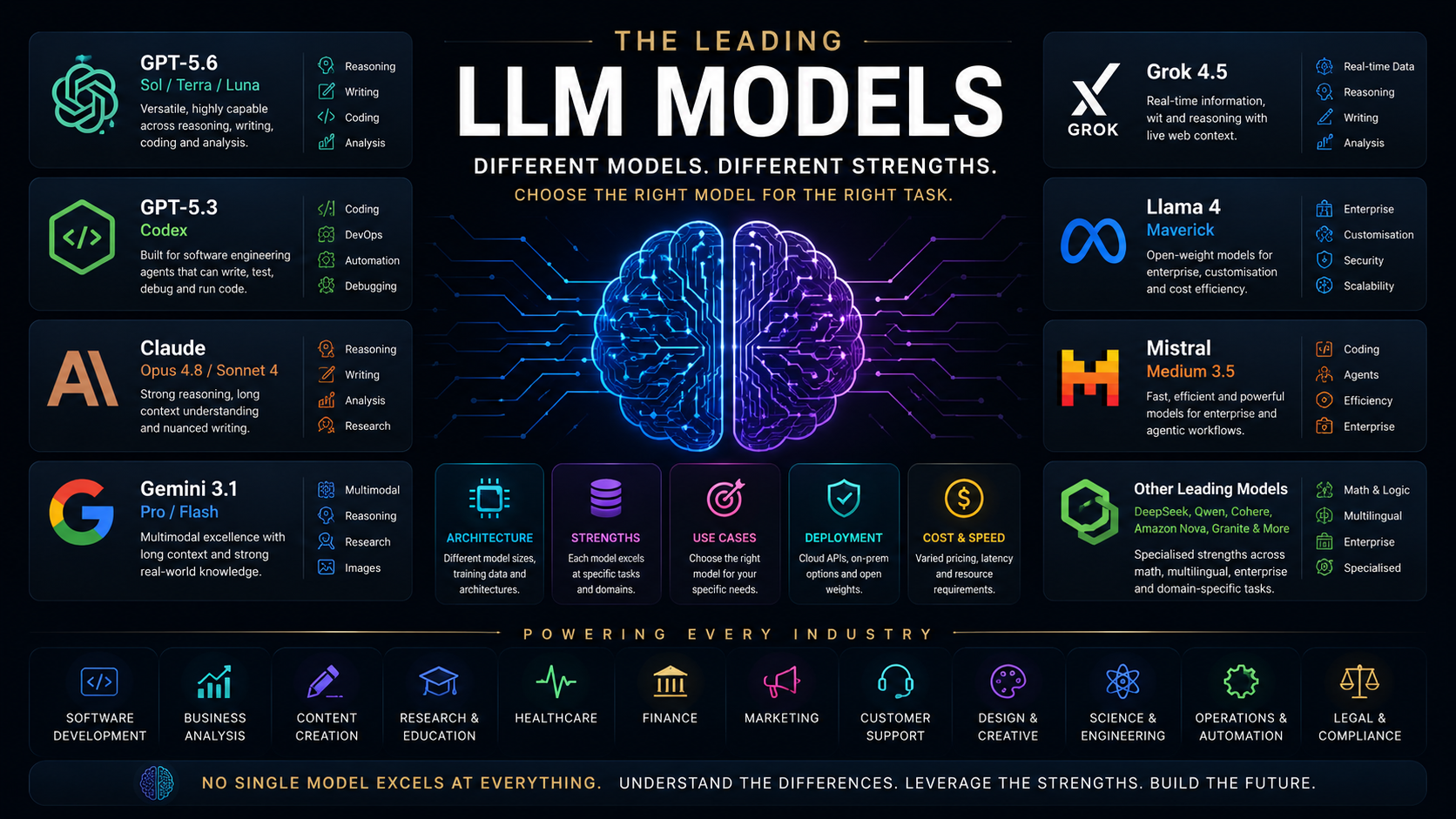
| Family | Strengths | Typical Uses |
|---|---|---|
| OpenAI GPT‑5.6 | Reasoning, writing, coding | Professional knowledge work |
| OpenAI Codex | Repository engineering, agents | Software development |
| Claude | Long context, writing, analysis | Research, enterprise documents |
| Gemini | Multimodal, large context | Documents, video, images |
| Grok | General reasoning | Interactive assistants |
| Llama 4 | Open-weight deployment | Private enterprise AI |
| Mistral | Coding, multilingual | Self-hosted assistants |
| DeepSeek | Maths and coding | Technical workloads |
| Qwen3 | Multilingual reasoning | International deployments |
| Cohere Command | Enterprise RAG | Knowledge assistants |
| Amazon Nova | AWS integration | Business automation |
| IBM Granite | Governed enterprise AI | Private deployments |
Detailed Focus: Codex
Why Codex is Different
Unlike general conversational models, Codex is designed around software engineering workflows. It understands repositories, edits multiple files, generates tests, assists with debugging, creates CI/CD pipelines, works with Docker and Kubernetes, and supports agentic development.
- Repository-aware development
- Multi-file refactoring
- Automated testing
- Terminal workflows
- Infrastructure as Code
- Git integration
- Code review assistance
- Documentation generation
Choosing the Right Model
- Research: GPT‑5.6 Sol, Claude Fable 5
- Coding: GPT‑5.3 Codex, Claude Opus 4.8, Devstral 2
- Creative writing: Claude Sonnet 5, GPT‑5.6 Terra
- Low-cost automation: GPT‑5.6 Luna, Claude Haiku, Gemini Flash‑Lite
- Private deployment: Llama 4, Mistral, Qwen3, Granite
Deployment Checklist
- Define the task.
- Select the smallest capable model.
- Benchmark with your own data.
- Add retrieval for current information.
- Monitor quality, cost and latency.
- Review model updates regularly.