
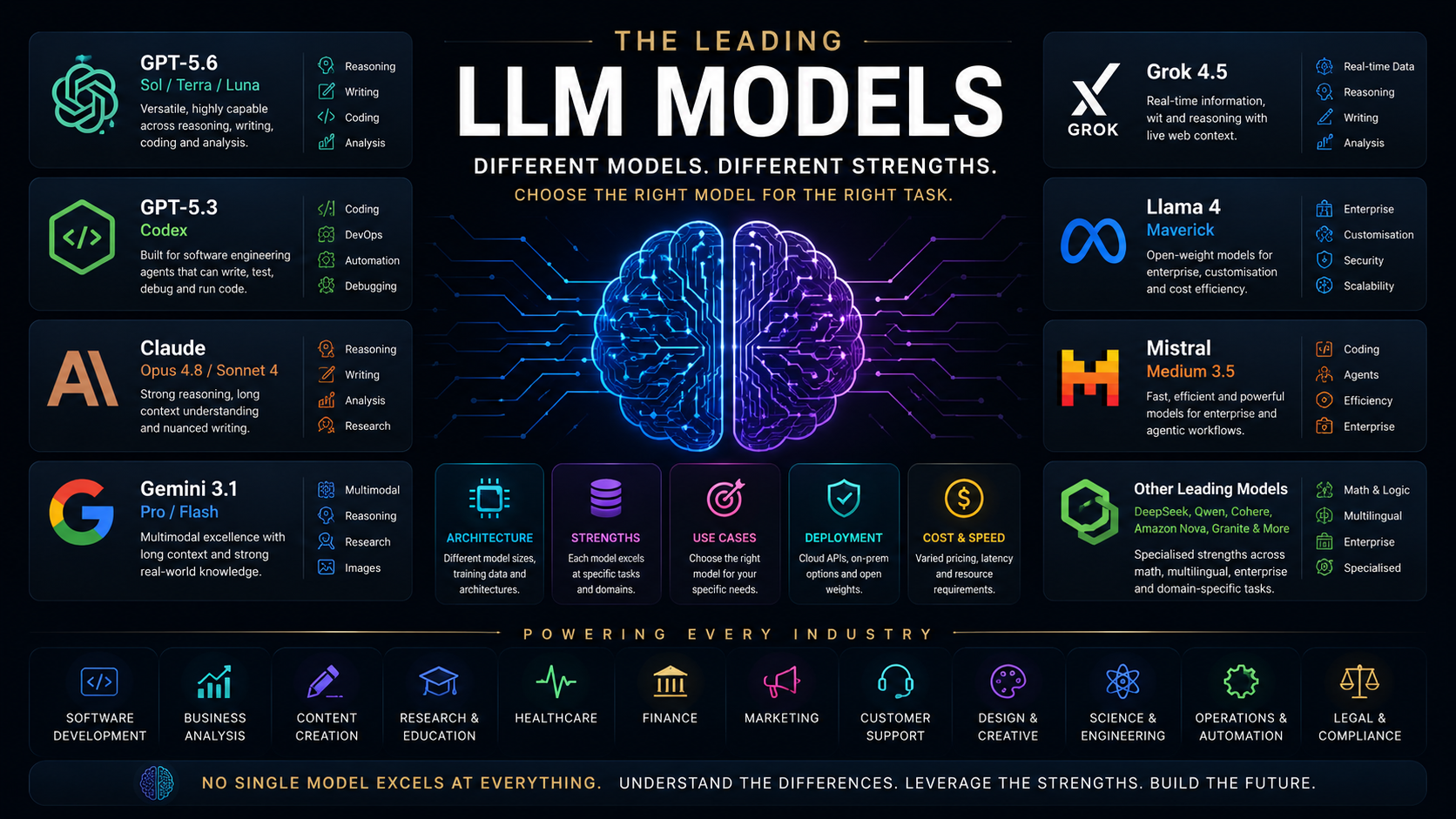
Current Large Language Models and What They Generate Best (TickTockIT)
Large language models are no longer interchangeable chatbots. Current model families differ in reasoning depth, coding ability, writing style, context handling, multimodal input, tool use, deployment options, governance, latency and cost.
This comprehensive Version 3 guide explains the major active model families, what each is best at generating, where OpenAI Codex fits, and how organisations should choose between frontier, balanced, small, open-weight and specialist models.
Scope: This guide focuses on model families relevant to professional users, developers and organisations. Model names, aliases, preview status, pricing and retirement dates change rapidly. Verify the provider's current documentation before creating a production dependency.
Quick Selection Guide
| Requirement | Strong candidates | Why |
|---|---|---|
| Deep professional reasoning | GPT-5.6 Sol; Claude Fable 5; Gemini 3.1 Pro | Difficult synthesis, planning and high-value knowledge work. |
| Repository-scale software engineering | GPT-5.3-Codex; Claude Opus 4.8; Devstral 2 | Multi-file changes, tests, debugging and terminal work. |
| Everyday professional generation | GPT-5.6 Terra; Claude Sonnet 5; Gemini 3.5 Flash; Mistral Medium 3.5 | Strong balance of quality, speed and cost. |
| High-volume automation | GPT-5.6 Luna; Claude Haiku; Gemini Flash-Lite; Nova 2 Lite | Extraction, classification, routing and templated content. |
| Open-weight/private deployment | Llama; Mistral; Qwen; DeepSeek; Granite | Greater hosting and customisation control. |
| Long-document/multimodal analysis | Gemini; Claude; Nova; Granite Vision | Large files, images, charts, PDFs, audio or video. |
What “Best” Means
Public benchmarks do not represent every real workflow. A model should be evaluated against the quality of the required output, its ability to complete the whole task, tool reliability, latency, total cost, context handling, deployment constraints and governance requirements.
- Output quality: factual accuracy, completeness, clarity and adherence to instructions.
- Task completion: whether the model finishes the workflow rather than merely suggesting an approach.
- Tool reliability: correct API calls, terminal use, structured output and retrieval.
- Operational fit: latency, cost, scaling, data retention and auditability.
OpenAI Codex: More Than Code Completion
Codex is a specialist software-engineering platform. It should not be treated as simply another conversational LLM that produces isolated code snippets.
What GPT-5.3-Codex Generates Best
- Complete features spanning multiple files and directories.
- PowerShell, Python, PHP, JavaScript, TypeScript, C#, Java, SQL and shell scripts.
- Unit, integration and regression tests.
- Dockerfiles, Compose files, Kubernetes manifests and infrastructure-as-code definitions.
- CI/CD workflows, Git automation and repository documentation.
- Database migrations, API clients, webhooks and third-party integrations.
- Repository-wide refactoring and software migrations.
- Bug fixes grounded in logs, test failures and reproducible behaviour.
Codex is most valuable when it can inspect the repository and use a controlled development environment. It can plan changes, edit multiple files, run commands, inspect the result, correct failures and present a reviewable diff. The unit of work becomes a software-engineering task rather than a single prompt.
When to Use Codex
- The project structure and existing code matter.
- The task requires changes across several files.
- Tests or build commands must be executed.
- A migration or refactor must preserve existing behaviour.
- The output must be a working implementation, not only an explanation.
When a General Model Is Better
- Writing reports, proposals, policies or marketing material.
- Explaining a coding concept without changing a repository.
- Broad research and synthesis.
- Producing a small standalone example.
Codex Governance
Repository agents should operate with least-privilege credentials, branch protection, test environments, secret controls, human review and audit logs. Generated code must be reviewed as contributed code rather than automatically trusted code.
Major Current Model Families
OpenAI GPT-5.6 Sol
Best for: Complex professional reasoning, scientific and technical analysis, architecture, cybersecurity, advanced coding and difficult multi-step work.
The flagship option when quality matters more than minimum cost or latency. It is the strongest general OpenAI choice for work combining reasoning, tools, code, vision and polished professional output.
OpenAI GPT-5.6 Terra
Best for: Business writing, reports, analysis, documentation, code assistance and everyday professional work.
A balanced model for organisations that need strong capability without routing every task to the flagship tier.
OpenAI GPT-5.6 Luna
Best for: High-volume summarisation, extraction, classification, routing, short support responses and lightweight subagents.
Designed for throughput, low latency and cost-sensitive production workloads.
OpenAI GPT-5.3-Codex
Best for: Repository-scale engineering, multi-file implementation, debugging, refactoring, migrations, tests, terminal operations and DevOps.
A specialist agentic coding model intended to inspect repositories, modify files, run commands, interpret failures and produce reviewable software changes.
Claude Fable 5
Best for: Demanding reasoning, long-horizon agents, complex research synthesis and major document tasks.
Anthropic's highest-capability widely released model for sustained planning and difficult work.
Claude Opus 4.8
Best for: Complex agentic coding, enterprise workflows, planning and large-codebase work.
Strong when tool use and long-running execution are more important than minimum latency.
Claude Sonnet 5
Best for: Everyday coding, professional writing, content development, document analysis and responsive assistants.
A strong balance of capability, speed and cost.
Claude Haiku
Best for: Rapid extraction, summarisation, support automation, classification and lightweight agents.
Designed for high-throughput and low-latency applications.
Gemini 3.1 Pro
Best for: Complex reasoning, large documents, codebases, multimodal research and precise tool use.
Best suited to difficult, mixed-media and long-context tasks; verify preview status before production use.
Gemini 3.5 Flash
Best for: Fast agentic loops, multimodal applications, coding cycles, subagents and scaled production workflows.
Targets high capability with lower latency and cost than the largest Pro tier.
Gemini 3.1 Flash-Lite
Best for: High-frequency extraction, lightweight multimodal processing, summarisation and classification.
Optimised for low latency, high volume and cost-sensitive multimodal work.
xAI Grok
Best for: General reasoning, conversational generation, coding assistance and current-information workflows when search is enabled.
Particularly useful when deployed with web or platform search, but current claims should still be verified.
Meta Llama 4 Maverick
Best for: High-quality self-hosted assistants, multimodal applications, custom enterprise deployment and fine-tuning.
Suitable where organisations want more control over hosting and data boundaries.
Meta Llama 4 Scout
Best for: Efficient private deployment, long-context retrieval systems and constrained infrastructure.
A more deployment-friendly option within the Llama family.
Mistral Medium 3.5
Best for: Agentic applications, coding, multimodal business work and general professional generation.
A frontier-class Mistral option for enterprise agents and coding.
Mistral Small 4
Best for: Efficient instruction following, reasoning, coding and self-hosted assistants.
Useful where cost and infrastructure matter but a capable general model is still required.
Mistral Large 3
Best for: Large open-weight multimodal deployment, multilingual generation and custom enterprise systems.
A large open-weight model for organisations wanting substantial control.
Mistral Devstral 2
Best for: Software-engineering agents, repository navigation, issue resolution and code modification.
A specialist coding model rather than a general creative-writing system.
Cohere Command
Best for: Enterprise retrieval, multilingual business assistants, tool use and grounded responses.
Well suited to RAG systems operating over private organisational data.
Amazon Nova 2 Pro
Best for: Complex multi-step reasoning, long-range planning, multimodal analysis and sophisticated agents.
Amazon's high-capability Nova tier; verify current preview or production status.
Amazon Nova 2 Lite
Best for: Everyday business automation, customer-service assistants, document processing and economical reasoning.
Designed for broad production use within AWS and Bedrock.
DeepSeek
Best for: Mathematics, reasoning, code and open-model experimentation.
Attractive for technical workloads and flexible deployment, subject to security, licensing and data-handling review.
Alibaba Qwen
Best for: Multilingual assistants, private deployment, coding, mathematics and a broad range of model sizes.
Useful when an organisation needs several deployment sizes within one family.
IBM Granite 4.1
Best for: Enterprise instruction following, tool calling, code generation, mathematics and controlled private deployment.
Available in several sizes and designed for governed enterprise use.
IBM Granite Vision
Best for: Tables, charts, forms, diagrams, scanned documents and visual retrieval.
Specialised for enterprise document understanding rather than general-purpose conversation.
Specialist Model Categories
Embedding Models
Embedding models convert text or images into vector representations for semantic search, recommendations, clustering and retrieval-augmented generation. They do not normally generate prose and should not be compared directly with chat models.
Rerankers
Reranking models improve search quality by reordering retrieved documents before they are given to the generative model.
Vision and Document Models
These models extract information from PDFs, forms, tables, screenshots, charts and diagrams. For document automation, a specialist vision or OCR model may outperform a more expensive general model.
Speech Models
Speech systems cover transcription, translation, text-to-speech and real-time speech-to-speech conversation. Audio support should be evaluated separately from text reasoning.
Safety and Guardian Models
Guardian models classify risks, detect unsafe prompts, evaluate outputs or enforce organisation-specific criteria. They supplement rather than replace access control and human oversight.
What Each Model Type Generates Best
| Required output | Preferred model type | Guidance |
|---|---|---|
| Research report | Frontier reasoning model with search and citations | Use verified sources rather than internal model memory. |
| Working software change | Repository-aware coding agent | Use Codex, Opus or Devstral with tests and controlled terminal access. |
| Marketing copy | Balanced conversational model | Evaluate tone, originality and brand adherence. |
| Customer-service response | Fast small model with retrieval | Ground responses in approved policies and account data. |
| Document extraction | Small multimodal or OCR specialist | Use a strict schema and validation. |
| Legal or compliance draft | Strong model with approved sources | Require qualified human review. |
| Private knowledge assistant | Enterprise RAG or open-weight model | Prioritise retrieval quality, access control and auditability. |
| Classification and routing | Small model | Use fixed labels, confidence thresholds and fallbacks. |
| Mathematics and engineering | Reasoning model plus tools | Verify calculations independently. |
Context Windows
A large context window permits more material to be supplied, but it does not guarantee that every detail will be recalled or interpreted correctly. Very large prompts can increase cost, latency and confusion. Effective systems retrieve the most relevant material, remove duplication and preserve clear source boundaries.
Multimodal Capability
“Multimodal” may mean image input, PDF analysis, audio or video understanding, image generation, speech generation or computer use. A model that analyses images is not automatically an image-generation model. Each required modality should be tested separately.
Open Weight, Open Source and Proprietary
- Proprietary hosted model: accessed through an API or managed application.
- Open-weight model: downloadable weights under a licence, without necessarily exposing training data or the full development process.
- Open-source model: code, weights and licensing intended to meet open-source criteria.
- Private hosted model: deployed in the organisation's cloud, data centre or local device.
Self-hosting provides control but transfers responsibility for infrastructure, updates, security, scaling, monitoring and evaluation to the organisation.
Cost and Model Routing
A mature production system rarely sends every request to the most expensive model. A typical routing design sends simple extraction and classification to a small model, escalates difficult reasoning to a frontier model, routes repository work to Codex or another coding agent, and sends images or documents to a multimodal specialist.
Evaluation Framework
- Create a test set containing real organisational work.
- Define measurable acceptance criteria.
- Test several candidate models with identical source material.
- Measure hallucinations, omissions and tool-call failures.
- Measure latency and total operational cost.
- Record the amount of human correction required.
- Repeat the evaluation after major model or prompt changes.
Security and Governance
- Apply least-privilege tool and data access.
- Separate trusted instructions from untrusted document content.
- Protect secrets and credentials.
- Log model, prompt, tool calls and final actions.
- Require human approval for consequential actions.
- Use independent validation in medical, legal, financial and safety-critical work.
- Track model versions, aliases and retirement notices.
Recommendations by User Type
IT Professionals
Use a balanced general model for documentation and troubleshooting, Codex for scripts and repositories, and a small model for ticket classification or routine extraction.
Software Developers
Use Codex, Claude Opus or Devstral for repository work. Retain a general frontier model for architecture, requirements, threat modelling and technical explanation.
Businesses
Prioritise retrieval, governance, predictable cost and integration. A smaller model grounded in company data can be more useful than a frontier model without access to current business information.
Content Creators
Evaluate tone, originality, long-form coherence and editing control. Balanced conversational models usually provide better value than specialist reasoning or coding models.
Private Deployment
Evaluate Llama, Mistral, Qwen, DeepSeek and Granite. Include the full cost of inference infrastructure, operations, model updates and security.
Model Selection Checklist
- Define the required output.
- Determine whether current external information is required.
- Identify tool, retrieval, code-execution or repository requirements.
- Set accuracy, latency and cost thresholds.
- Determine privacy and deployment constraints.
- Test multiple models using real examples.
- Measure failure modes as well as successful demonstrations.
- Use the smallest model that reliably meets the requirement.
- Add escalation to a stronger model for difficult cases.
- Monitor provider changes and model retirement.
Final Recommendation
There is no single best LLM. For difficult general work, begin with a frontier reasoning model. For everyday professional work, use a balanced model. For software-engineering execution, use Codex, Claude Opus or Devstral. For high-volume routine work, use a smaller model. For private deployment, evaluate open-weight families such as Llama, Mistral, Qwen, DeepSeek and Granite.
The strongest production architecture is often a combination of models, retrieval, tools, validation and human approval rather than dependence on one model for every task.
Official Sources
- OpenAI models
- GPT-5.3-Codex
- OpenAI Codex application
- Anthropic Claude models
- Google Gemini models
- Mistral models
- Amazon Nova models
- IBM Granite 4.1
Version 3 comprehensive edition. Last reviewed: 16 July 2026.