



What Are Large Reasoning Models? (TickTockIT)
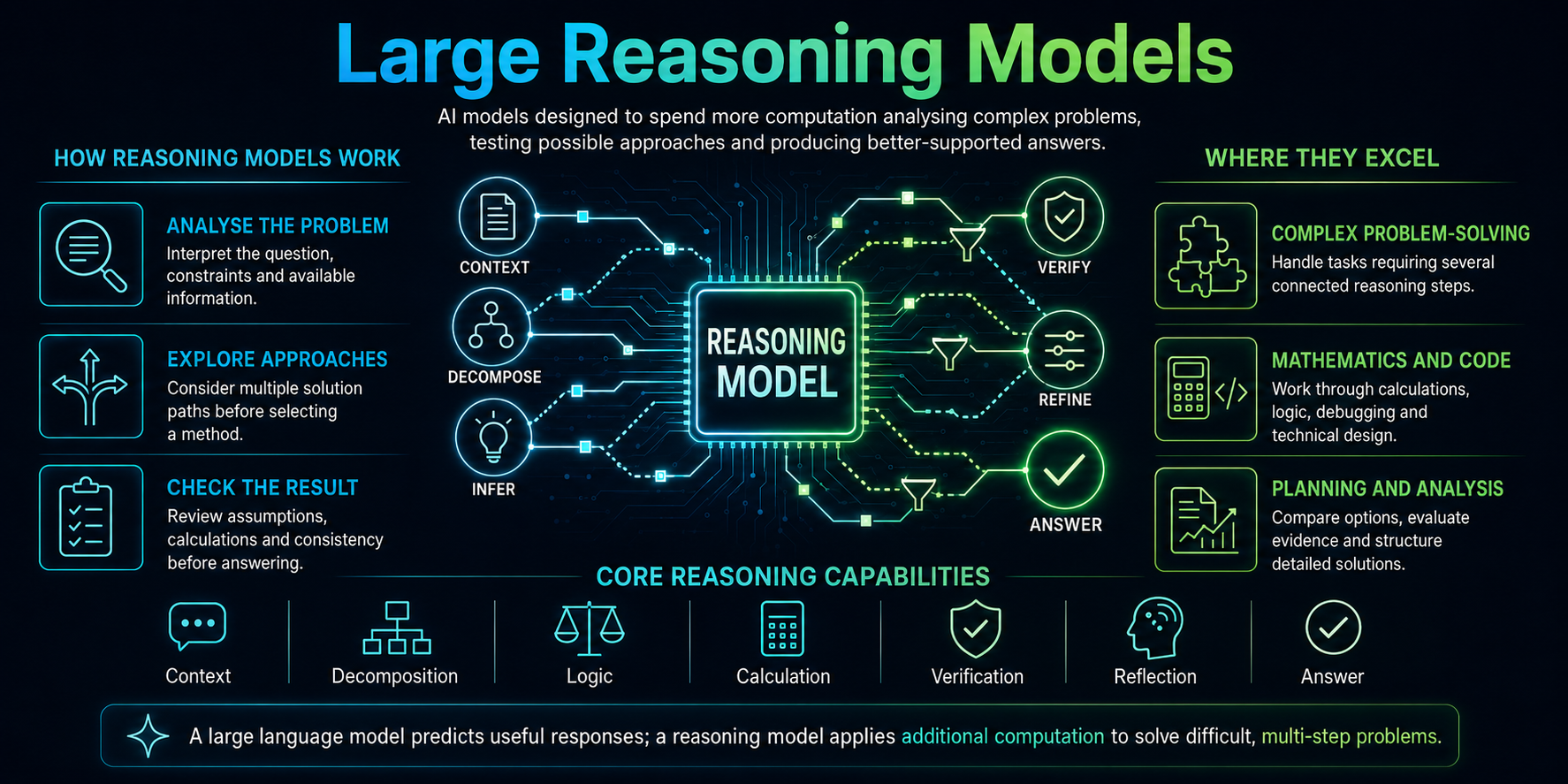
Large reasoning models are advanced artificial intelligence systems designed to spend more computational effort analysing a problem before producing an answer. They are particularly useful for tasks that require several connected steps, careful planning, logical deduction, mathematical analysis, coding or the comparison of competing possibilities.
They are closely related to large language models, but their purpose is not limited to predicting fluent text. A reasoning model is trained and configured to work through difficult problems, check intermediate conclusions, revise unsuccessful approaches and select a stronger final response.
This does not mean that reasoning models think or understand in the same way as people. They remain statistical machine-learning systems and can still make confident mistakes. Their advantage is that they can apply additional computation to complex tasks instead of responding immediately.
What Does “Large Reasoning Model” Mean?
The term large reasoning model, often shortened to LRM, describes a model built to perform extended inference. Inference is the processing that occurs when a trained AI model receives a request and generates a result.
For a straightforward question, the model may answer quickly. For a difficult task, it can use more inference-time computation to analyse requirements, explore possible solutions and verify parts of its work.
“Large” usually refers to the model’s substantial training, architecture and computational requirements. The exact number of parameters is often undisclosed and is not, by itself, a reliable measure of reasoning quality.
How LRMs Relate to Large Language Models
A large language model learns statistical patterns from very large collections of text, code and other data. It generates an output by predicting suitable tokens based on the input and the context already produced.
A large reasoning model normally uses the same broad transformer foundations but is further trained or configured to handle multi-step problems more effectively. It may spend considerably longer processing a request before returning the answer.
The categories overlap. Many current AI products use a family of models in which some versions are optimised for speed and general conversation while others are optimised for deliberate reasoning.
Standard LLMs and Reasoning Models Compared
- Primary strength: standard LLMs prioritise fast, fluent responses; reasoning models prioritise complex problem solving.
- Processing: standard models often answer directly; reasoning models may perform extended internal analysis.
- Speed: standard models are generally faster; reasoning models can take longer.
- Cost: reasoning models usually consume more computation and may cost more per request.
- Best tasks: standard models suit drafting and routine questions; reasoning models suit planning, mathematics, coding and difficult analysis.
- Reliability: reasoning can improve difficult answers, but neither type is guaranteed to be correct.
Why Reasoning Models Were Developed
Conventional language models can produce convincing responses without correctly solving the underlying problem. This weakness becomes obvious in mathematics, program logic, scientific analysis and tasks containing several dependent constraints.
Simply increasing the amount of training data or the size of a model does not solve every problem. Developers therefore began focusing more heavily on techniques that improve the model’s behaviour during problem solving.
Reasoning models aim to make better use of computation at the point when a user submits a difficult request.
Inference-Time Computation
Inference-time computation is one of the central ideas behind reasoning models. Instead of using approximately the same effort for every prompt, the system can allocate more processing to a demanding problem.
Additional computation may be used to consider alternative approaches, test assumptions, check calculations, analyse tool results or refine a proposed solution.
More computation does not guarantee a correct answer. It improves the opportunity to find and correct errors, but a model can also spend longer pursuing a mistaken assumption.
How Reasoning Models Are Trained
Reasoning models begin with large-scale pre-training, during which they learn patterns in language, code, mathematics and other data. They then undergo additional training intended to improve problem solving and instruction following.
Developers may use examples of successful reasoning, automatically verified tasks, human feedback and reinforcement learning. In reinforcement learning, the model receives signals that reward useful behaviour and discourage poor results.
Tasks with objectively checkable answers—such as mathematics, logic and executable code—are valuable because the training system can determine whether a result is correct.
Reasoning Traces and Intermediate Work
During a complex task, a reasoning model may generate internal intermediate work before returning its final response. This is sometimes described as a reasoning trace or chain of thought.
The complete internal trace is not necessarily shown to the user. Products may instead provide a concise summary of the approach, partly because raw internal reasoning can be confusing, unreliable or contain sensitive implementation details.
A visible explanation should be judged against evidence and results. A plausible-sounding explanation is not proof that the model reached the answer correctly.
Planning and Breaking Problems into Steps
Large reasoning models are useful when a goal must be divided into smaller tasks. They can identify dependencies, decide the order of operations and adjust the plan when new information appears.
For example, a software task may require the model to inspect the existing code, identify the source of a fault, design a change, implement it, run tests and revise the solution if those tests fail.
Planning ability also makes reasoning models important components of AI agents, although an agent requires tools, permissions, memory and an execution framework in addition to the model itself.
Using Tools
A reasoning model can be connected to tools such as web search, databases, code execution, calculators, document stores and business applications.
The model can decide which tool is appropriate, construct the request, inspect the result and use that evidence in its next step. This is often more reliable than asking the model to rely entirely on information stored in its training.
Tool access must be controlled. A model that can reason about an action should not automatically be permitted to perform that action in a live system.
Reasoning Models and AI Agents
A reasoning model and an AI agent are not the same thing. The model provides analysis and decision-making capability; the agent is the larger software system that pursues a goal and takes actions.
An agent may combine a reasoning model with instructions, tools, memory, permissions, monitoring and human approval. It may also route easy work to a faster model and reserve the reasoning model for difficult decisions.
The quality of an agent therefore depends on much more than the underlying model. Poor tool design or excessive permissions can make a capable reasoning model unsafe or ineffective.
Where Large Reasoning Models Perform Well
Reasoning models are most valuable where a correct answer requires several connected decisions or the application of multiple constraints.
Strong use cases include software development, mathematical problem solving, scientific analysis, technical troubleshooting, complex document review, strategic planning and multi-stage research.
They can also compare alternative proposals, identify missing information and explain why a particular course of action was selected.
Software Development and Coding
Programming is well suited to reasoning models because code can often be executed and tested. The model can analyse a codebase, trace dependencies, propose changes and use test results as feedback.
It may be able to diagnose errors, refactor existing code, create tests, explain unfamiliar systems or coordinate work across several files.
Human review remains necessary, particularly for security, data handling, performance and changes to production systems.
Mathematics and Logical Problems
Multi-step mathematics requires the model to preserve intermediate values, apply the correct operations and verify the final result. Reasoning models generally perform better on these tasks than models optimised mainly for rapid text generation.
They can also work with formal logic, constraints, schedules and optimisation problems where several conditions must be satisfied simultaneously.
They still make arithmetic and interpretation errors. Important results should be verified with calculators, specialist software or independent review.
Scientific and Technical Analysis
Reasoning models can assist with analysing experimental results, comparing hypotheses, interpreting technical literature and planning investigations.
They are useful for connecting evidence from several sources, but they do not replace subject-matter expertise, reproducible methods or peer review.
Scientific claims should be supported by traceable sources and verified data rather than accepted because the model’s explanation appears coherent.
IT Support and Troubleshooting
An LRM can organise troubleshooting into a logical sequence: identify symptoms, collect relevant configuration information, compare possible causes, select diagnostic tests and revise the hypothesis based on the results.
It can help distinguish between account, device, network, service and permissions problems rather than providing a generic list of fixes.
For live environments, read-only diagnostics should normally be separated from configuration changes, and consequential actions should require approval.
Research and Document Analysis
Reasoning models can examine several documents, identify agreements and contradictions, extract relevant evidence and produce a structured conclusion.
When connected to search or a controlled document library, they can gather information beyond the model’s original training data.
Source citations must be checked. Models can misinterpret documents, overlook qualifications or associate a claim with the wrong source.
When a Reasoning Model Is Unnecessary
Many tasks do not benefit from extended reasoning. Rewriting a short paragraph, formatting text, translating a simple message or answering a routine factual question may be handled faster and more cheaply by a general-purpose model.
Traditional software is preferable when the required operation is completely deterministic. A calculator, database query, validation rule or script can provide a more predictable result than an AI model.
Using the most powerful model for every request increases cost and delay without necessarily improving the outcome.
Limitations of Large Reasoning Models
Reasoning models can still hallucinate facts, misunderstand a request, use an invalid assumption or produce an incorrect conclusion. Extra analysis reduces some errors but does not eliminate them.
They may also overcomplicate simple tasks, consume excessive time, produce inconsistent results or fail when a problem differs substantially from their training.
A polished explanation can create false confidence. Results should be evaluated by correctness and evidence, not by fluency or apparent certainty.
Reasoning Has Practical Limits
Performance does not improve indefinitely as more processing is added. A model can reach a point where additional steps create little benefit or introduce new errors.
Some problems require missing facts, real-world observation, specialist tools or human judgement rather than additional model computation.
Systems should impose reasonable limits on processing time, tool calls and expenditure and should escalate when progress has stopped.
Accuracy and Verification
Reasoning models should be encouraged to check their work, use reliable tools and identify uncertainty. However, self-checking by the same model is not fully independent verification.
High-impact answers should be validated against authoritative documentation, executable tests, calculations or qualified human review.
For business use, the system should record sources, tool results, approvals and actions so that an outcome can be audited.
Privacy and Confidential Information
Requests to reasoning models may contain customer data, source code, contracts, health information or security details. Organisations must understand how the selected service stores, processes and retains that information.
Access should follow least-privilege principles, and sensitive data should be removed when it is not required for the task.
Model use must comply with the organisation’s security policies, contractual obligations and applicable data-protection requirements.
Security Risks
When an LRM is connected to tools, malicious text may attempt to manipulate its decisions. Prompt injection can appear in webpages, documents, messages or retrieved records.
Security controls must be enforced by the surrounding application rather than relying only on instructions given to the model.
Restricted permissions, isolated execution, action allowlists, approval gates and detailed audit logs are essential for consequential operations.
Speed and Cost
Reasoning models commonly take longer to answer because they perform more processing. Their use can also involve higher charges and increased computing demand.
The difference may be minor for an occasional difficult question but substantial for an automated system handling thousands of requests.
A practical design routes routine work to faster models and invokes extended reasoning only when complexity or risk justifies it.
Choosing a Reasoning Model
Choose a model by testing it against representative tasks from the intended workflow. General benchmark scores do not show how well it will handle a specific organisation’s data, terminology and constraints.
Compare accuracy, tool use, response time, consistency, cost, privacy controls, deployment options and the ability to follow required output formats.
Evaluation should include difficult cases, incomplete information, malicious inputs and situations where the correct behaviour is to request human assistance.
How to Prompt a Reasoning Model
Provide a clear objective, the necessary context, relevant constraints and the required output format. State which sources or tools should be used and what must not be assumed.
Complex tasks benefit from clear success criteria. It is usually more useful to specify the result and validation requirements than to force the model to imitate a particular hidden reasoning process.
Ask it to identify uncertainty, cite evidence where appropriate and stop for clarification when essential information is missing.
How Organisations Should Deploy LRMs
Begin with a narrow, measurable and low-risk use case. Test the model with real examples in an isolated environment before connecting it to production systems.
Use controlled tools, separate identities, least-privilege permissions, human approval for important actions and continuous monitoring.
Measure task success, error severity, human correction, processing time and total cost. Increased autonomy should be earned through evidence rather than assumed from a demonstration.
Large Reasoning Models Are Still Developing
Reasoning capability is improving quickly, but there is no single accepted test that completely measures it. Models may perform extremely well in one domain and fail on a superficially simple variation.
Future systems are likely to combine faster general models, specialist reasoning models, external tools, structured memory and verification components.
The most dependable results will come from systems that use AI reasoning selectively and surround it with conventional software controls.
Final Thoughts
Large reasoning models are language-based AI systems optimised to apply additional computation to complex problems. Their main strength is the ability to plan, analyse several connected steps, use tools and revise an approach before returning a result.
They are particularly effective for coding, mathematics, technical analysis, research and troubleshooting. They are slower and more expensive than models designed for quick responses and remain capable of serious errors.
LRMs should therefore be treated as powerful problem-solving components rather than infallible authorities. Used for the right tasks, with reliable evidence, controlled tool access and human oversight, they can substantially improve the quality of complex analytical work.