

How Artificial Intelligence Is Affecting the Environment (TickTockIT)
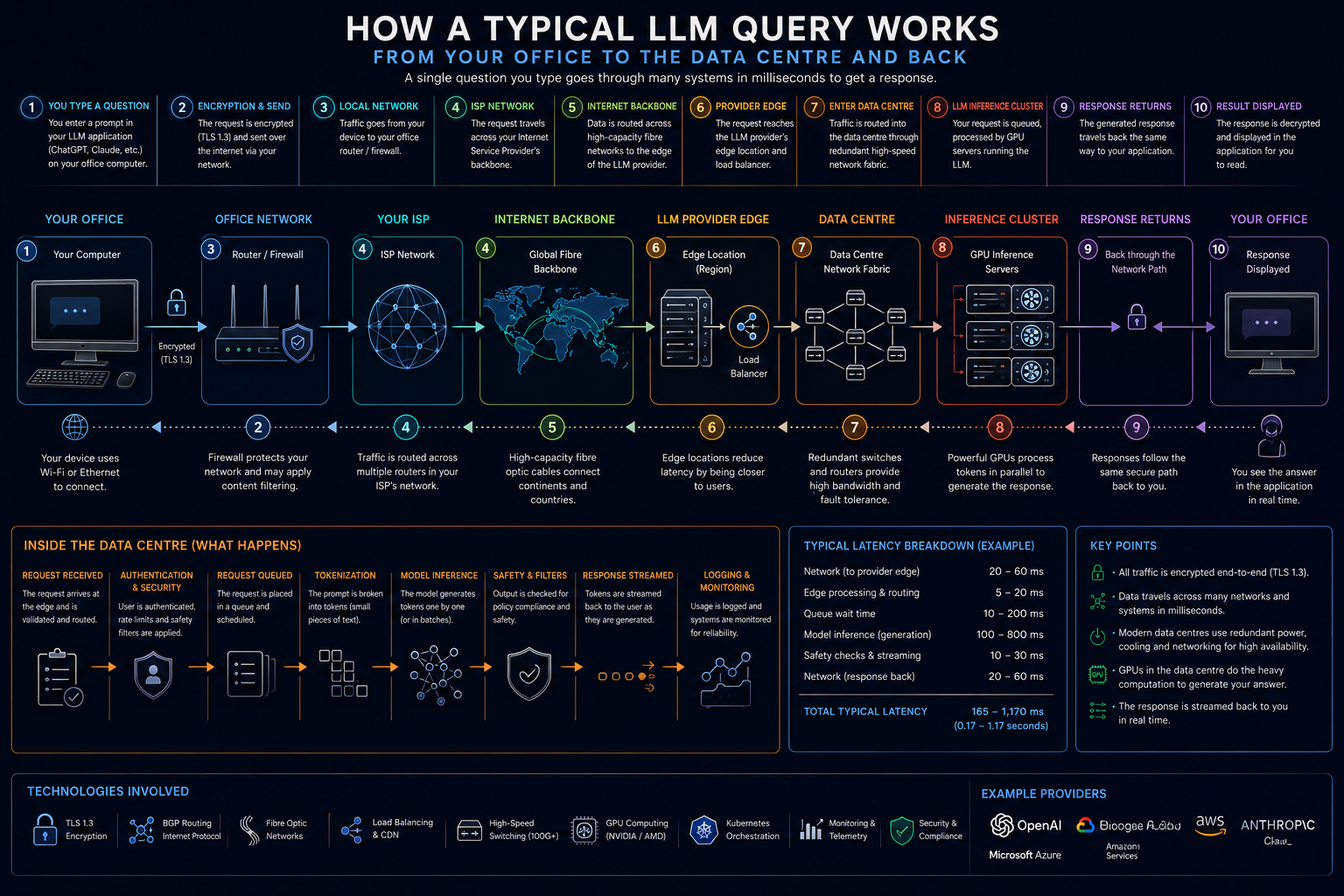
Artificial intelligence is transforming software, business, healthcare, science, transport, media, and public services. Behind every AI response, however, is a physical infrastructure of data centres, processors, cooling systems, electricity networks, water supplies, mines, factories, and global supply chains.
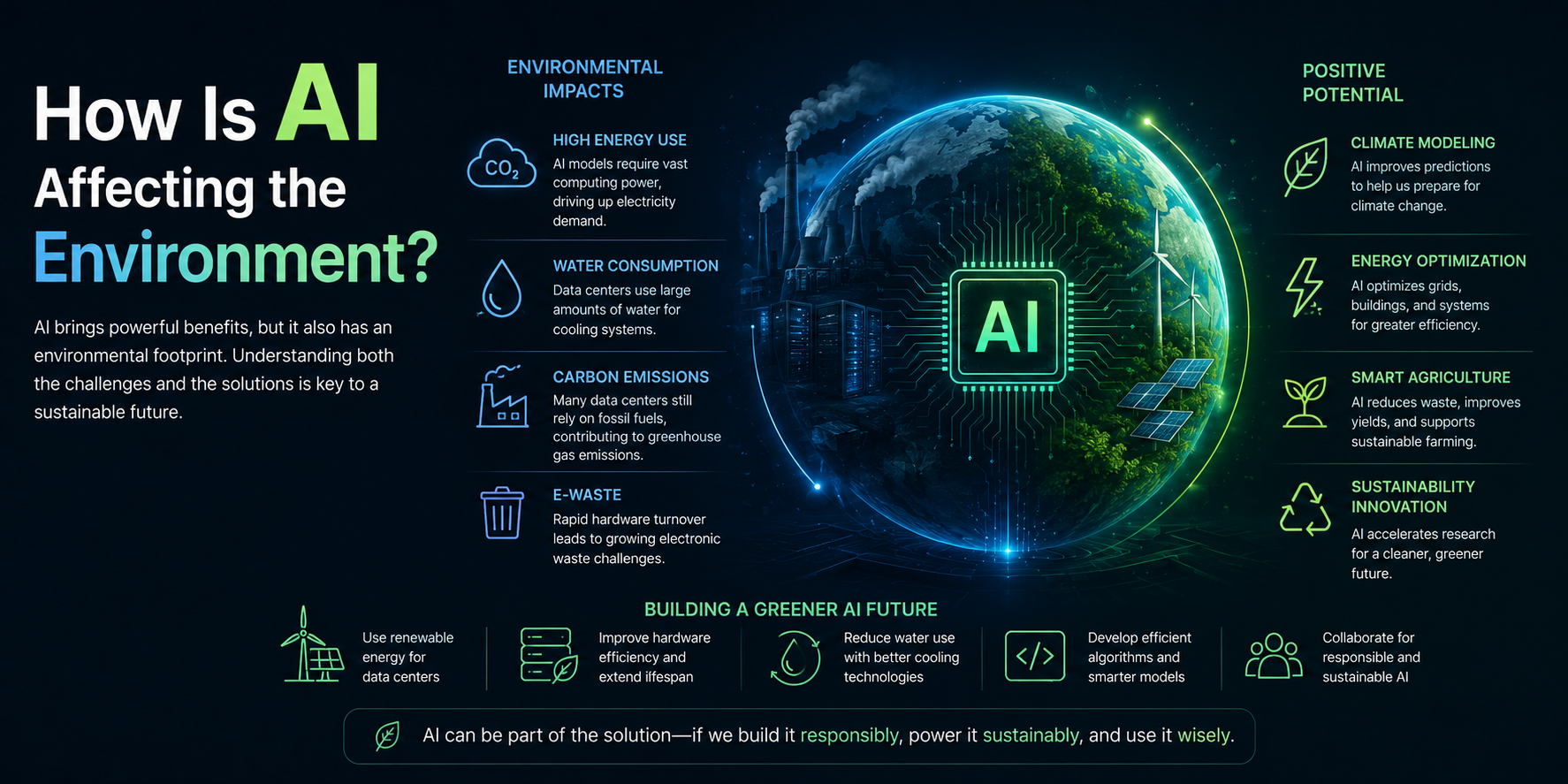
The environmental impact of AI is not limited to the electricity used when someone enters a prompt. It includes the manufacture of specialised hardware, data-centre construction, model development, training, everyday inference, cooling, networking, equipment replacement, and electronic waste.
AI can also support environmental progress. It can improve weather forecasting, optimise energy systems, reduce waste, monitor ecosystems, detect leaks, improve transport planning, and accelerate scientific research. The central issue is whether these benefits will outweigh the rapidly growing physical demands of AI infrastructure.
AI Is Not an Immaterial Technology
AI is often presented as a cloud-based service, making it appear detached from the physical world. In reality, the cloud consists of buildings filled with servers, networking equipment, storage systems, cooling machinery, backup generators, electrical switchgear, and high-capacity grid connections.
Modern AI systems rely heavily on graphics processors, AI accelerators, high-bandwidth memory, and fast interconnects. These components consume energy while operating and require energy, water, metals, chemicals, and industrial equipment to manufacture.
Every AI workload therefore has a material footprint. Its scale depends on the model, hardware, data centre, energy source, cooling method, location, workload, and frequency of use.
Rapid Growth in Data-Centre Electricity Demand
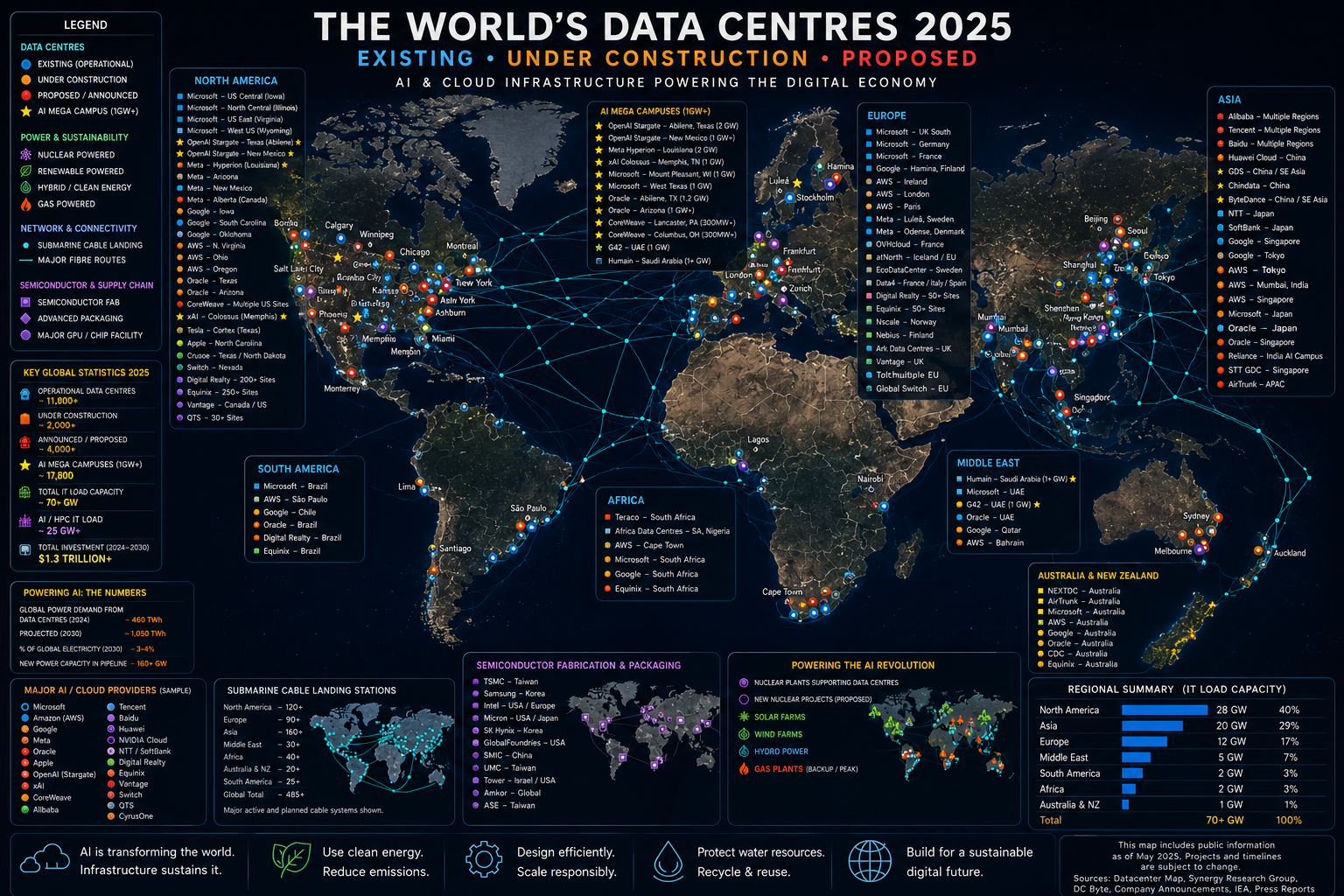
The expansion of generative AI is increasing demand for data-centre computing capacity. The International Energy Agency reported global data-centre electricity consumption of about 485 terawatt-hours in 2025 and projected that it could rise to approximately 950 terawatt-hours by 2030.
AI-focused facilities are expected to account for a substantial part of this growth because advanced AI servers can draw far more power than conventional business servers.
The global percentage can appear modest, but the effect is concentrated. A large data-centre campus can place heavy demand on a regional grid and require new generation, substations, transmission lines, and backup capacity.
Training Large AI Models
Training an advanced AI model can involve thousands of specialised processors operating continuously for weeks or months. The system repeatedly processes enormous datasets while adjusting billions or trillions of internal parameters.
The electricity used by the final training run is only part of the total. Developers may conduct many experiments, failed runs, evaluations, data-processing stages, and architecture searches before producing a released model.
Research has shown that model-development activity can represent a large share of total environmental impact, although public disclosures often concentrate only on the final training run.
Inference Can Exceed Training Over Time
Inference occurs whenever an AI model answers a question, generates an image, analyses a file, writes code, translates text, or performs another task.
A popular model may serve millions or billions of requests. Even when each request uses much less energy than training, continuous global use can eventually exceed the energy used to create the model.
Long prompts, complex reasoning, large outputs, image and video generation, repeated retries, and agentic workflows that call several tools can all increase demand.
The Carbon Footprint Depends on the Electricity Source
Electricity consumption does not translate into a fixed quantity of carbon emissions. The result depends on how electricity is generated at the time and location where the workload runs.
A data centre supplied mainly by wind, solar, hydroelectric, or nuclear power will generally have lower operational emissions than one relying heavily on coal or natural gas.
Annual renewable-energy purchases do not necessarily guarantee that every workload is matched with clean electricity at the hour it runs. Hourly carbon accounting and location-aware scheduling provide a more accurate picture.
Pressure on Electricity Grids
Electricity grids must continuously balance supply and demand. Large AI facilities can require hundreds of megawatts and may expand faster than new power stations and transmission infrastructure can be built.
Where clean generation is insufficient, utilities may extend the life of fossil-fuel plants, construct additional gas generation, or operate existing plants more intensively.
Grid constraints can also delay housing, industrial investment, public infrastructure, and renewable-energy connections. AI must therefore be considered as part of a wider regional energy system.
Water Consumption for Cooling
AI servers generate large quantities of heat. This heat must be removed to prevent equipment failure and maintain performance. Some data centres use evaporative cooling systems that consume water during heat rejection.
Water demand varies according to climate, facility design, cooling technology, workload, season, and incoming-water temperature.
Water use becomes particularly controversial when data centres are built in drought-prone areas or regions where households, agriculture, industry, and ecosystems already compete for limited supplies.
Indirect Water Use
A data centre’s direct water consumption does not capture its full water footprint. Many power stations also use water for cooling, fuel extraction, steam generation, and other processes.
An AI workload can therefore have indirect water impacts through the electricity grid even when the data centre itself uses air cooling or a closed-loop system.
Meaningful water accounting should include both on-site consumption and water used in generating electricity.
Cooling Technology and Environmental Trade-Offs
Air cooling can reduce direct water use but may consume more electricity during hot weather. Evaporative cooling can reduce electricity demand while consuming more water.
Direct-to-chip liquid cooling removes heat more efficiently from high-density AI processors. Closed-loop systems can reuse coolant and reduce evaporation, although pumps, heat exchangers, and external heat rejection are still required.
There is no universally ideal cooling system. The best design depends on climate, water availability, electricity carbon intensity, heat-reuse opportunities, and equipment characteristics.
Manufacturing AI Chips
The environmental impact begins before a server is switched on. Advanced processors are manufactured in semiconductor plants that require substantial quantities of electricity, ultra-pure water, gases, solvents, photoresists, metals, and specialist chemicals.
Leading-edge chips pass through hundreds or thousands of tightly controlled process steps. Yield losses mean that not every chip produced from a wafer is usable, increasing the resources required per functioning device.
Memory, storage, networking equipment, circuit boards, power supplies, cooling hardware, and data-centre construction materials add further embodied carbon and resource consumption.
Mining and Critical Raw Materials
AI hardware depends on copper, aluminium, silicon, gold, tin, tantalum, cobalt, nickel, rare-earth elements, and other materials.
Mining and refining can cause habitat destruction, soil contamination, water pollution, greenhouse-gas emissions, and social conflict.
Rapid infrastructure expansion also increases demand for steel, concrete, transformers, electrical cables, batteries, and cooling equipment.
Construction and Embodied Carbon
Data centres are large industrial buildings requiring concrete, steel, insulation, piping, electrical systems, generators, batteries, cooling equipment, and extensive groundworks.
Cement and steel production are major sources of carbon emissions. Construction-related emissions can therefore rise even when operational electricity becomes cleaner.
Several large technology companies have reported that expansion of data-centre infrastructure and supply-chain activity is making long-term climate targets harder to achieve.
Electronic Waste and Short Hardware Cycles
AI hardware is developing quickly. New accelerator generations often provide greater performance, more memory, and better energy efficiency, creating pressure to replace equipment before the end of its physical life.
Retired servers, processors, networking equipment, storage devices, batteries, and cooling systems contribute to electronic waste.
Reusing equipment for less demanding workloads, refurbishing components, recovering materials, designing modular systems, and extending hardware lifetimes can reduce this impact.
Local Noise, Heat, and Air Pollution
Data centres can affect nearby communities through cooling-fan noise, construction traffic, visual impact, and backup-generator operation.
Diesel generators are commonly installed to maintain service during grid failures. Routine testing and emergency use can release nitrogen oxides, particulates, and greenhouse gases.
Facilities also reject large quantities of low-grade heat. Where this heat is not recovered, it is released into the surrounding air or water.
Waste Heat Can Be Reused
Data-centre heat can sometimes be captured and supplied to district heating systems, greenhouses, swimming pools, offices, housing, or industrial processes.
Heat reuse works best where suitable demand is close to the data centre and the facility is designed for recovery from the beginning.
The heat temperature may need to be raised with heat pumps, but this can still reduce fossil-fuel use for heating.
The Rebound Effect
More efficient AI hardware does not automatically reduce total environmental impact. Efficiency often lowers the cost of computation, encouraging developers and users to consume more of it.
This is the rebound effect. A model that becomes twice as efficient may be used five times as often, resulting in higher total electricity consumption.
Environmental improvement therefore requires attention to total demand, not only efficiency per query.
Generative Images, Audio, and Video
Different AI tasks have different computing requirements. Generating high-resolution images generally requires more computation than producing a short text response.
Audio generation, image editing, three-dimensional content, and especially video generation can require substantially more processing and data movement.
As generated media becomes more realistic and resolutions increase, environmental impact will depend heavily on how often these services are used and how efficiently they are implemented.
AI Agents Can Multiply Computing Demand
An AI agent may perform many steps for a single user request. It can search documents, read files, call services, generate code, run tests, analyse failures, revise its work, and repeat the process.
This can deliver greater practical value than a single chatbot response, but it can also require many model calls and substantial supporting computation.
Agentic systems should avoid unnecessary loops, duplicated work, excessive context, and repeated use of large models where smaller tools would be sufficient.
Environmental Benefits of AI
AI is not environmentally harmful in every application. It can reduce emissions and resource use when applied to a clearly defined problem and measured against a realistic baseline.
Potential benefits include improved energy forecasting, optimised heating and cooling, better logistics, predictive maintenance, lower industrial waste, more accurate weather models, and faster development of low-carbon materials.
The environmental value of an AI system should be assessed by comparing the resources it consumes with the emissions, waste, or damage it genuinely prevents.
Renewable-Energy Optimisation
Wind and solar generation vary with weather. AI can improve forecasts of output and demand, helping grid operators schedule storage, generation, and electricity transfers more efficiently.
Machine-learning systems can identify faults in solar panels, predict wind-turbine maintenance, and optimise battery charging.
These uses can improve renewable-energy reliability, although conventional statistical methods may sometimes achieve similar results with less computation.
Climate and Weather Forecasting
AI is increasingly used to supplement traditional physics-based weather and climate models. It can produce forecasts quickly and detect patterns in large datasets.
Improved predictions of storms, floods, heatwaves, and other extreme events can help communities prepare and protect infrastructure.
AI does not remove the need for physical climate science, observation networks, satellites, or numerical models. Strong systems often combine machine learning with established scientific methods.
Agriculture and Food Production
AI can analyse satellite images, soil data, weather records, and sensor readings to support irrigation, fertiliser application, crop monitoring, pest detection, and yield forecasting.
Precision agriculture can reduce unnecessary water, chemicals, and fuel use. Benefits depend on reliable data, affordable equipment, farmer access, and suitable local practices.
The technology should support rather than replace ecological knowledge and responsible land management.
Monitoring Ecosystems and Biodiversity
AI can process camera-trap images, acoustic recordings, satellite data, and drone footage to identify species, detect deforestation, monitor coral reefs, track illegal fishing, and map habitat change.
Automated analysis can allow conservation teams to process far more data than would be possible manually.
These systems still require validation because inaccurate classifications or biased datasets can lead to poor environmental decisions.
Reducing Waste and Improving Recycling
Computer-vision systems can identify materials on recycling lines and help automated equipment separate paper, plastics, glass, metals, and contaminants.
AI can forecast demand, optimise stock levels, identify manufacturing defects, and reduce food waste across supply chains.
The benefit depends on whether the technology produces a real reduction in waste rather than merely adding another layer of equipment and data processing.
Transport and Logistics
AI can optimise delivery routes, reduce empty vehicle journeys, predict traffic, improve fleet maintenance, and support more efficient public transport.
Small percentage improvements can produce substantial fuel savings across large logistics networks.
However, cheaper and faster delivery can stimulate additional demand, offsetting some efficiency gains.
Measuring the True Environmental Impact
There is no single universally adopted method for measuring the complete environmental footprint of an AI system.
Companies may report operational electricity while excluding hardware manufacturing, model-development experiments, water use, construction, or supplier impacts.
Meaningful assessment should include energy use, carbon intensity, direct and indirect water consumption, embodied emissions, materials, equipment lifespan, electronic waste, and the consequences of actual use.
The Need for Greater Transparency
Model developers rarely disclose enough information for independent researchers to calculate the complete impact of advanced AI systems.
Useful disclosures would include processor type, training duration, energy use, data-centre location, carbon intensity, cooling technology, water consumption, development overhead, inference volume, and hardware lifecycle data.
Standardised reporting would allow customers, policymakers, investors, and researchers to compare systems more accurately.
Choosing the Right Model for the Task
Not every problem requires the largest available model. Smaller specialised models can often classify text, extract data, detect anomalies, or answer narrow questions using much less computation.
Routing simple requests to smaller models and reserving large models for genuinely difficult tasks can reduce energy use and cost.
Traditional software, databases, search systems, rules, and statistical methods may sometimes solve the problem more efficiently than generative AI.
Improving Model and Hardware Efficiency
Quantisation, pruning, distillation, sparsity, caching, efficient attention, improved compilers, and better scheduling can reduce the resources required to run AI models.
New processors can deliver more computation per watt, while improved memory and networking reduce data-movement overhead.
Efficiency gains must be combined with controls on unnecessary demand to prevent rebound effects from overwhelming the savings.
Locating Data Centres Responsibly
Data-centre location has a major influence on environmental impact. Suitable sites should have access to low-carbon electricity, resilient grids, responsible water supplies, and opportunities for heat reuse.
Facilities should not be placed in water-stressed regions without a credible plan to avoid harming communities and ecosystems.
Planning decisions should consider cumulative regional demand rather than assessing each data centre in isolation.
What Technology Companies Can Do
Technology companies can measure lifecycle emissions, publish transparent data, purchase additional clean electricity, match demand with clean power hourly, reduce water use, and extend hardware lifetimes.
They can prioritise efficient models, eliminate unnecessary computation, recover waste heat, use lower-carbon construction materials, and require suppliers to reduce emissions.
Environmental targets must account for absolute growth. A data centre can become more efficient per unit of computation while the company’s total footprint continues to rise.
What Organisations Using AI Can Do
Businesses and public organisations should ask whether an AI use case creates enough value to justify its environmental and financial cost.
They can reduce demand by avoiding duplicate services, limiting unnecessary generation, selecting smaller models, shortening prompts, reusing outputs, caching common responses, and deleting obsolete data.
Procurement policies can require suppliers to disclose energy, emissions, water, and hardware information rather than relying on broad sustainability claims.
What Individual Users Can Do
Individual AI use is only one part of the total impact, but behaviour still matters at large scale.
Users can write clear prompts, avoid repeated regeneration, choose text rather than image or video generation where appropriate, and use conventional search or software for simple tasks.
The objective is not to avoid every AI interaction. It is to use computation deliberately rather than treating it as an unlimited and consequence-free resource.
Regulation and Environmental Standards
Governments can require data-centre operators and major AI providers to report electricity consumption, water use, emissions, heat recovery, and local infrastructure effects.
Planning rules can encourage construction where sufficient clean energy and water are available while protecting communities from pollution, noise, and resource competition.
Standards should require comparable data rather than allowing organisations to select whichever measurement presents them most favourably.
Balancing Benefits Against Environmental Cost
The environmental debate around AI is not a simple choice between unrestricted growth and abandoning the technology.
Some applications can produce significant social and environmental benefits. Others may consume substantial resources to generate low-value advertising, disposable content, spam, or unnecessary automation.
A responsible approach asks whether the application is necessary, whether a smaller system can perform the task, whether its impact is measured, and whether the claimed benefit occurs in practice.
Final Thoughts
Artificial intelligence is becoming a major new source of demand for electricity, water, semiconductor manufacturing, construction materials, and data-centre capacity.
Its footprint extends across the full lifecycle, from mining and chip fabrication to training, inference, cooling, infrastructure construction, and electronic waste.
AI can also help address environmental problems by improving energy systems, forecasting extreme weather, reducing waste, supporting conservation, and accelerating scientific discovery.
The outcome will depend on how the technology is powered, designed, measured, regulated, and used. Efficiency alone will not be enough if total demand continues to grow without limit.
AI should be treated as a powerful but resource-intensive industrial technology. Used selectively, transparently, and responsibly, it can contribute to environmental progress. Expanded without effective controls, it risks increasing the very pressures it is sometimes claimed to solve.
Sources and Further Reading