



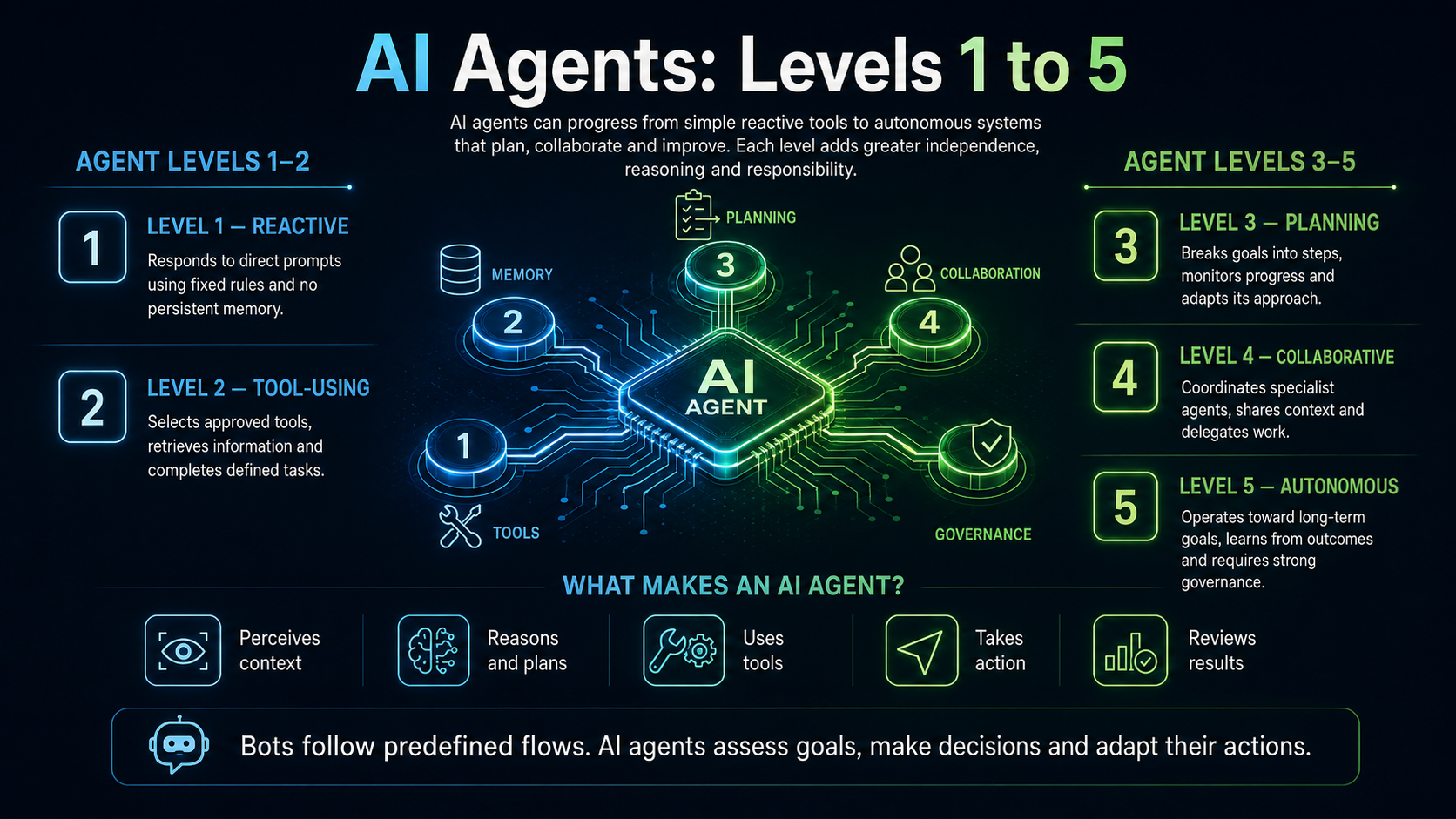
AI Agents: Levels 1 to 5 and How They Differ from Bots (TickTockIT)
AI agents are software systems that can understand a goal, decide what to do, use tools, take action and adapt as work progresses. They range from simple systems that respond to one instruction at a time to highly autonomous systems capable of planning and coordinating complex work.
The term AI agent is often used loosely. A useful way to understand the technology is to divide it into five levels according to autonomy, planning ability, memory, tool use and the amount of human supervision required.
Bots and agents can look similar because both may communicate through a chat interface. The real difference is not how they appear but how they operate. A bot usually follows a predefined conversation or set of rules, whereas an agent can reason about a goal, choose actions and adjust its approach.
What Is an AI Agent?
An AI agent is a software system designed to pursue an objective rather than merely produce a single response. It can receive information, interpret the current situation, decide on a next step, perform an action and assess the result.
Depending on its level, an agent may search the web, read documents, query databases, write and run code, update business systems, send approved communications or coordinate other specialist agents.
The defining feature is a continuing cycle of observation, decision, action and review. This allows the system to make progress across several steps instead of waiting for a human to specify every individual instruction.
AI Agent Levels Are a Practical Classification
There is no single universal industry standard that officially defines AI agent levels 1 to 5. The model used here is a practical classification for comparing systems by capability and autonomy.
A higher level does not automatically mean that a system is better. Many business tasks are safer, cheaper and more reliable when handled by a tightly controlled Level 1 or Level 2 agent.
The appropriate level depends on the task, the quality of available data, the consequences of an error, the permissions granted to the system and the organisation’s ability to monitor its actions.
Level 1: Reactive or Assistant Agents
A Level 1 agent responds to a direct instruction and normally completes one clearly defined task. It does not independently create a substantial plan or continue working towards a broader objective.
Examples include summarising a document, drafting an email, answering a question, classifying a support ticket or extracting fields from an invoice.
These systems may use an AI model, but their behaviour remains closely controlled by the user’s prompt and the application around it. They generally have limited memory and require a new instruction before taking the next significant step.
Typical Level 1 Characteristics
- Responds to one prompt or event at a time.
- Performs a narrow and clearly bounded task.
- Uses little or no persistent memory.
- Does not independently pursue a long-term goal.
- Keeps the human in direct control of each action.
Level 2: Tool-Using Agents
A Level 2 agent can select and use approved tools to complete a task. Instead of only generating text, it may retrieve current information, search company files, query a database, perform calculations or call an external service.
For example, a support agent could inspect a device record, search a knowledge base and draft a recommended fix. A sales agent could retrieve current customer information and prepare a personalised follow-up.
The task is still usually short and well defined. Tool permissions, validation rules and human approval remain important because the agent can now interact with real data and systems.
Typical Level 2 Characteristics
- Selects from a controlled set of tools.
- Retrieves information beyond its original training data.
- Can complete several connected actions.
- Operates within strict permissions and boundaries.
- Often requires approval before making external changes.
Level 3: Planning Agents
A Level 3 agent can take a broader goal, break it into steps and decide the order in which those steps should be completed. It can review intermediate results and revise its plan when an action fails or new information appears.
A Level 3 IT agent might investigate an incident by collecting logs, checking recent changes, comparing symptoms with known issues, testing possible causes and producing a remediation plan.
This level introduces meaningful autonomy. The agent is no longer following a fixed sequence; it is choosing a route through the task. Checkpoints, audit logs, spending limits, time limits and approval gates become essential.
Typical Level 3 Characteristics
- Breaks a goal into multiple tasks.
- Chooses and revises a plan dynamically.
- Maintains working context across a longer process.
- Checks results before moving to the next stage.
- Escalates important decisions or exceptions to a human.
Level 4: Collaborative Multi-Agent Systems
A Level 4 system uses several specialised agents that cooperate on a complex objective. One agent may coordinate the work while others perform research, coding, analysis, testing, security review or quality assurance.
For example, a software-development system could use a planning agent to define the work, a coding agent to implement it, a testing agent to validate it and a review agent to inspect security and quality.
Multi-agent systems can handle larger workloads, but they also introduce coordination problems. Agents may duplicate work, disagree, pass incorrect assumptions to one another or consume excessive computing resources. Clear responsibilities and a reliable supervisory process are required.
Typical Level 4 Characteristics
- Coordinates multiple specialist agents.
- Delegates subtasks according to capability.
- Shares context, results and status between agents.
- Uses review or supervisory agents to check output.
- Requires strong controls for access, cost and accountability.
Level 5: Highly Autonomous Agents
A Level 5 agent can pursue a long-running objective with limited human intervention. It may create plans, allocate resources, use multiple tools, learn from results, recover from failures and continue operating over an extended period.
A genuinely capable Level 5 business agent might monitor operational conditions, identify problems, decide when action is needed, coordinate specialist systems and report outcomes rather than requesting instructions at every stage.
This remains the most demanding and highest-risk level. Full autonomy is inappropriate where actions could affect finances, security, legal obligations, employment, safety or critical infrastructure without robust oversight and clearly defined limits.
Typical Level 5 Characteristics
- Pursues broad, long-term objectives.
- Plans and acts with minimal routine supervision.
- Adapts to changing conditions and unexpected failures.
- Manages resources, tools and specialist agents.
- Requires continuous monitoring, governance and emergency controls.
How the Five Levels Compare
Level 1 responds. Level 2 uses tools. Level 3 plans. Level 4 coordinates specialists. Level 5 operates towards long-term goals with substantial autonomy.
The progression is therefore not simply about producing more intelligent answers. Each level increases the system’s ability to choose what happens next and to affect systems outside the conversation.
As autonomy increases, so do the requirements for identity management, permissions, monitoring, logging, testing, human approval, rollback procedures and accountability.
What Is a Bot?
A bot is a program that automatically performs a repetitive or predefined task. Traditional bots commonly rely on rules, decision trees, keywords, scripts or scheduled events.
Examples include a website chat widget that presents fixed menu choices, a monitoring bot that sends an alert when a server goes offline, or a messaging bot that returns an order status when given an order number.
Bots can be useful and reliable precisely because their behaviour is constrained. They do not need to understand a broad objective if their job is to perform the same known action consistently.
The Main Difference Between Agents and Bots
A bot generally follows a predefined path: when a particular event occurs, it executes a specified response. An AI agent is given an objective and can decide which path, tools and actions are most appropriate.
A bot asks, “Which rule applies?” An agent asks, “What should I do next to achieve the goal?”
The distinction is not absolute. Modern bots may include language models, and agents often contain rule-based components. The important issue is how much independent decision-making the overall system is permitted to exercise.
Bots and Agents Compared
- Purpose: bots automate predefined tasks; agents pursue defined objectives.
- Decision-making: bots normally follow rules; agents can reason about alternative actions.
- Workflow: bots use fixed flows; agents can build or revise a plan.
- Tool use: bots call predetermined functions; agents may choose among available tools.
- Memory: bots usually retain limited state; agents may maintain working or persistent memory.
- Adaptation: bots handle expected inputs; agents can respond to new information and failures.
- Risk: bots are generally predictable; agents require stronger supervision as autonomy increases.
When a Bot Is the Better Choice
A bot is often the better solution when the process is stable, repetitive and governed by precise rules. Password-reset workflows, scheduled alerts, standard data transfers and fixed customer-service menus do not necessarily benefit from autonomous reasoning.
Using an AI agent where ordinary automation is sufficient can increase cost, latency and unpredictability without creating meaningful value.
The correct design uses deterministic software for actions that must always behave the same way and reserves AI reasoning for uncertainty, interpretation and exceptions.
When an AI Agent Is the Better Choice
An agent is useful when the route to the desired result cannot be completely predefined. Research, troubleshooting, document analysis, software development and complex customer enquiries may require the system to interpret evidence and choose between several valid approaches.
Agents are particularly valuable when a human would normally need to collect information from several sources, compare it, make decisions and adjust the next step according to the result.
The agent should still be given a tightly defined objective, appropriate tools and explicit boundaries. Autonomy without limits is not a sound business requirement.
Human Oversight at Every Level
Human oversight should be matched to the consequences of the agent’s actions. A system that drafts an internal summary presents far less risk than one that changes firewall rules, transfers money or communicates with customers.
Low-risk actions may be automated, while high-impact actions should require review and approval. Agents must also be able to explain what they did, which information they used and where uncertainty remains.
Organisations should define who owns the agent, who reviews its behaviour, who can change its permissions and who is accountable when it makes an error.
Security and Permission Controls
An agent should receive only the access required for its assigned task. Giving a general-purpose agent unrestricted administrator credentials creates an unnecessary and serious security risk.
Strong implementations use separate identities, least-privilege permissions, short-lived credentials, action allowlists, isolated environments and approval gates for sensitive operations.
All important actions should be logged. Organisations also need a reliable way to pause the system, revoke access and reverse changes where possible.
Memory, Privacy and Data Protection
Agent memory can improve continuity, but it can also retain inaccurate, confidential or personal information. Persistent memory must therefore be treated as a managed data store rather than an informal extension of a chat session.
Organisations should control what the agent may remember, how long information is retained, who can access it and how it can be corrected or deleted.
Agents handling personal or commercially sensitive data must comply with the same privacy, security and retention requirements as other business systems.
Reliability and Testing
AI agents are probabilistic systems and can make incorrect assumptions, select the wrong tool or continue along an unproductive path. Greater autonomy amplifies the impact of these errors.
Testing should cover normal tasks, ambiguous instructions, missing information, tool failures, malicious inputs, permission boundaries and recovery from partial completion.
Performance should be measured by successful outcomes, error rates, cost, time, required human intervention and the severity of failures—not by how convincing the agent sounds.
Choosing the Correct Agent Level
Start with the lowest level capable of delivering the required outcome. Increase autonomy only when there is a clear benefit and the necessary controls are in place.
A useful implementation often combines levels. A Level 3 planning agent may analyse an incident, while fixed bots perform predictable data collection and a human approves any change to production systems.
This hybrid approach provides flexibility where reasoning is useful and predictability where correctness and control matter most.
Final Thoughts
AI agents differ from traditional bots because they can pursue objectives, select actions, use tools and adapt their plans. Bots remain valuable for predictable, rule-based automation and are frequently the safer and more efficient choice.
The five practical levels show a progression from reactive assistance to tool use, planning, multi-agent collaboration and highly autonomous operation. Each step adds capability but also introduces greater cost, complexity and risk.
The objective should not be to deploy the highest possible level. It should be to use the lowest level of autonomy that solves the problem reliably, with clear permissions, effective human oversight and full accountability.